When procurement managers and logistics teams evaluate pallet options for warehouse operations or export shipments, the choice between molded wood pallets and traditional solid wood pallets comes up consistently. Both are wood-based. Both handle standard forklift and pallet jack operations. But they are manufactured differently, perform differently under load and in transit, and carry significantly different implications for export compliance, total cost of ownership, and sustainability credentials.
This guide explains how molded wood pallets are made, how they compare to solid wood pallets across the key performance and compliance dimensions that matter to logistics and supply chain buyers, and which applications favor each option.
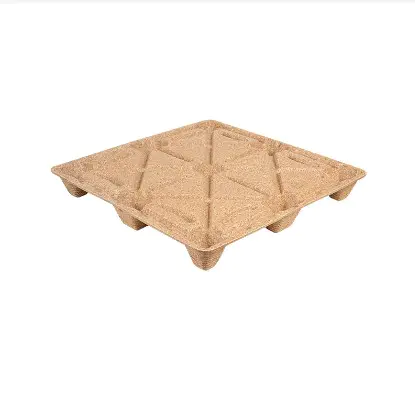
A molded wood pallet — also called a pressed wood pallet or composite wood pallet — is manufactured by compressing wood fiber (typically recycled wood waste, sawdust, wood chips, or agricultural residue) with adhesive binders under high heat and pressure in a steel mold. The result is a one-piece pallet with no individual boards, no nails, and no assembly joints. The entire structure is formed in a single pressing cycle, which means the pallet is dimensionally consistent from unit to unit and has no weak points at fastener locations.
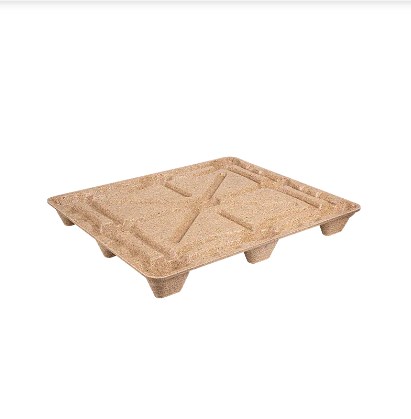
The manufacturing process has two important consequences that differentiate molded pallets from solid wood in nearly every performance dimension. First, the high-temperature pressing process — typically 150–200°C throughout the material — eliminates all biological material, including insects, larvae, and fungal spores. Second, the mold-formed construction allows complex geometric profiles — the nine-leg design, the chuan-shaped channel structure, the flat single-piece design — to be produced with precise, repeatable dimensions that hand-assembled solid wood pallets cannot match.
What Is a Traditional Solid Wood Pallet and How Is It Made?
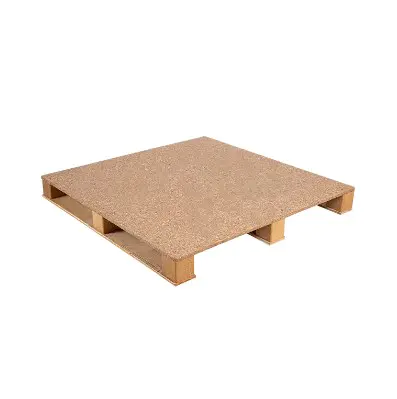
A traditional solid wood pallet is assembled from sawn timber boards — deck boards, stringers or blocks, and bottom deck boards — fastened together with nails or screws. The wood used is typically pine, oak, or locally available softwood species, sawn to standard dimensions and assembled either by hand or with semi-automated nailing machinery.
Solid wood pallets have been the global logistics standard for decades because sawn timber is widely available, easy to repair in the field, and familiar to every warehouse and logistics operation. However, the biological nature of solid wood — it contains the cellular structure of living trees, which can harbor insects and pathogens — creates specific compliance requirements for international shipments that molded wood pallets do not share.
Molded Wood Pallet vs Solid Wood Pallet: Direct Comparison
| Feature |
Molded Wood Pallet |
Solid Wood Pallet |
| Manufacturing method |
High-heat press molding — one-piece construction |
Hand or machine assembly of sawn timber boards |
| ISPM 15 fumigation requirement |
Exempt — not regulated wood packaging material |
Required for most international destinations |
| Weight (standard 1200×1000mm) |
Approximately 9–14 kg, depending on design |
Approximately 18–28 kg, depending on timber grade |
| Dimensional consistency |
Excellent — mold-controlled, ±1mm tolerance |
Variable — depends on timber quality and assembly |
| Static load capacity |
1,500–3,000 kg depending on design |
1,500–4,000 kg depending on timber grade and design |
| Pest and mold risk |
None — biological material eliminated in pressing |
Risk is present if not treated and certified |
| Moisture resistance |
Good — compressed fiber absorbs less moisture |
Lower — solid wood absorbs and releases moisture |
| Splinter and nail hazard |
None — no fasteners, smooth pressed surface |
Risk of protruding nails and wood splinters |
| Repairability |
Limited — one-piece construction, cannot replace boards |
Good — individual boards can be replaced |
| Recyclability |
High — wood fiber recyclable, no metal content |
Moderate — metal fasteners complicate recycling |
| Unit cost (standard size) |
Generally lower to comparable — depends on volume |
Variable — timber prices fluctuate with the market |
| Appearance consistency |
Uniform — no grain variation, consistent color |
Variable — natural wood variation in color and grain |
| Food safety suitability |
High — no nails, no splinters, smooth surface |
Lower nail and splinter contamination risk |
| Best application |
Export logistics, food industry, pharmaceutical, and cleanroom |
Domestic heavy-load warehousing, repairable pool systems |
Why ISPM 15 Compliance Is the Key Difference for Export Shipments
ISPM 15 — the International Standards for Phytosanitary Measures No. 15 — is a global plant protection standard that requires wood packaging materials used in international trade to be treated to eliminate the risk of spreading invasive insects and pathogens. The standard is enforced at the border by customs and plant health authorities in over 180 countries, including all major trade destinations: the United States, the European Union, Australia, Canada, Japan, and most of Southeast Asia.
For solid wood pallets used in export shipments, ISPM 15 compliance requires either heat treatment (HT — heating the wood to a core temperature of 56°C for 30 continuous minutes) or methyl bromide fumigation (MB — a chemical treatment that is being phased out in many countries due to its ozone-depleting properties). After treatment, the pallet must be marked with the official ISPM 15 stamp — the wheat-sheaf symbol — showing the country code, producer code, and treatment method. Pallets without this mark are subject to rejection, re-export, or destruction at the destination port, at the shipper's cost.
Molded wood pallets made from compressed wood fiber are classified as manufactured wood products — not raw or processed wood — and are therefore exempt from ISPM 15 requirements under the standard's scope definition. This exemption is not a technicality; it reflects the reality that the high-heat pressing process that creates molded pallets eliminates the biological risk that ISPM 15 is designed to address. For exporters, this exemption eliminates the treatment cost, the treatment lead time, and the compliance documentation requirement for every shipment — a meaningful operational and cost advantage at scale.
Load Performance and Structural Design
Nine-Leg Design
The most common molded wood pallet design for general export logistics is the nine-leg configuration: a top deck surface supported by nine molded-in leg columns arranged in a 3×3 grid pattern. This design provides four-way forklift entry — forks can enter from any of the four sides — and distributes load across nine contact points with the floor, which is better for racking systems than designs with fewer support points. The nine-leg design is available in single-sided format (one usable deck surface, one structured leg surface) and double-layer format for applications requiring higher rigidity under heavy static loads.
Chuan-Shaped Channel Design
The chuan-shaped (chuan-shaped) design features three continuous channel runners across the pallet length rather than individual leg columns. This design provides more consistent support across the deck surface and is particularly suited to goods that require even pressure distribution — bagged products, sheet materials, and flexible packaging. The flat chuan-shaped one-piece design combines the chuan runner structure with a flush top surface that maximizes contact area with the cargo base, reducing pressure concentrations that can damage packaging.
Chemical Fiber Reinforced Series
For applications requiring higher impact resistance and structural toughness beyond standard compressed wood fiber — heavy machinery components, metal parts, dense building materials — the chemical fiber series incorporates synthetic fiber reinforcement into the wood fiber composite matrix during pressing. The reinforcing fibers significantly increase the pallet's resistance to cracking under point loads and edge impacts, extending service life in high-stress handling environments.
Which Industries Benefit Most from Molded Wood Pallets?
Food and Beverage Industry
Food safety regulations in most major markets require that packaging materials in direct or near contact with food products present no contamination risk. Solid wood pallets with exposed nails, wood splinters, or untreated surfaces that can harbor bacteria fail this requirement in strict food-grade warehouse environments. Molded wood pallets have no metal fasteners, no splinter risk, and a smooth, uniform surface that can be cleaned and inspected efficiently. For exporters shipping food products to markets with stringent food safety regulations — the EU, the US, Japan — molded wood pallets simplify compliance significantly.
Chemical Industry
Chemical products packaged in drums, IBCs, and bags require pallets that resist chemical exposure, do not contribute contamination, and do not present ignition risks from metal fasteners. The compressed fiber construction of molded pallets is more resistant to chemical absorption than solid wood, and the absence of metal components eliminates the spark risk that is a concern in some chemical handling environments. For hazardous goods shipments, the consistent dimensional profile of molded pallets also ensures reliable compatibility with specialized racking and containment systems.
Pharmaceutical and Medical Devices
Pharmaceutical and medical device supply chains operate under GDP (Good Distribution Practice) guidelines that require packaging materials to protect product integrity and present no contamination risk throughout the distribution chain. The smooth, nail-free, splinter-free surface of molded wood pallets is directly aligned with these requirements. The ISPM 15 exemption also simplifies the documentation burden for international pharmaceutical shipments, which are already subject to extensive regulatory paperwork.
Electronics and Electrical Equipment
Electronics exporters face a specific risk from solid wood pallets: moisture. Solid wood absorbs and releases moisture with ambient humidity changes, and moisture-saturated pallets can damage moisture-sensitive electronic components and packaging. Molded wood's compressed fiber structure has significantly lower moisture absorption and release rates than solid sawn timber, making it a more stable platform for electronics shipments through humid environments and long sea freight transit times.
Frequently Asked Questions
Do molded wood pallets need ISPM 15 certification?
No. Molded wood pallets — also called pressed wood pallets or composite wood pallets — are classified as manufactured wood products and are explicitly exempt from ISPM 15 phytosanitary treatment requirements. This exemption applies globally and is recognized by customs authorities in all major importing countries. The exemption reflects the fact that the high-temperature pressing process used to manufacture molded pallets eliminates the biological risks (insects, pathogens) that ISPM 15 treatment is designed to address in solid wood packaging materials. Exporters using molded pallets do not need to obtain HT (heat treatment) or MB (methyl bromide) certification for their pallet materials.
Are molded wood pallets strong enough for heavy goods?
Yes — quality molded wood pallets are rated for static loads of 1,500–3,000 kg depending on design and construction. The nine-leg double-layer series and chemical fiber reinforced series are specifically engineered for heavier applications. The key is matching the pallet design and load rating to the application: a single-sided nine-leg pallet rated for 1,500 kg static load is appropriate for packaged goods, while machinery or dense building material shipments may require a higher-rated double-layer or reinforced design. Always confirm the pallet's dynamic load rating (load during forklift handling) in addition to the static rating, as dynamic load capacity is typically 30–50% lower than static capacity.
How does the weight of a molded wood pallet affect freight costs?
Molded wood pallets typically weigh 9–14 kg for a standard 1200×1000mm size, compared to 18–28 kg for an equivalent solid wood pallet. The weight difference — approximately 8–15 kg per pallet — has a direct impact on freight costs for weight-charged shipments, particularly air freight and some sea freight consolidation services where total shipment weight determines cost. For a container with 20 pallets, switching from solid wood to molded wood can reduce pallet tare weight by 160–300 kg — a meaningful freight saving on weight-sensitive shipments and an operational benefit for manual handling at the receiving end.
Can molded wood pallets be reused?
Yes — molded wood pallets are designed for multiple-use cycles under normal warehouse and logistics conditions. The one-piece construction eliminates the joint failures and loose boards that are the most common damage modes for solid wood pallets in pool circulation. In closed-loop supply chains where pallets are returned from the customer, molded pallets typically achieve 5–10 use cycles before requiring replacement. Unlike solid wood pallets, individual boards cannot be replaced when damaged, but the absence of fasteners means there are fewer failure modes, and the compressed fiber construction is more resistant to splitting and edge damage than sawn timber.
Molded Wood Pallets | Single-Sided Nine-Foot Pallet | Double-Layer Pallet Series | Chemical Fiber Series | Food Industry Solutions | Chemical Industry Solutions | Request a Quote
 English
 Français
 Español
 عربى
عربى