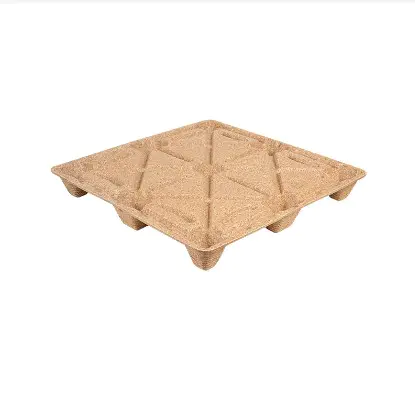
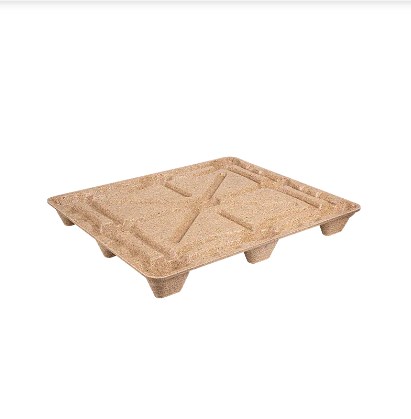
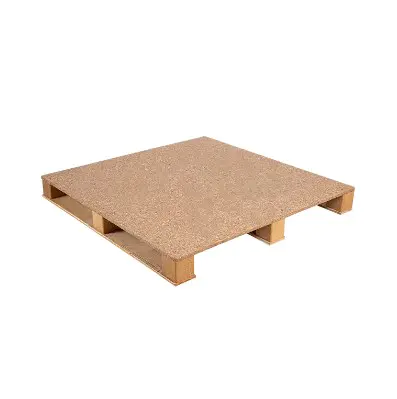
In modern logistics and warehouse management, pallets are an essential infrastructure. With the rise of supply chain efficiency and environmental awareness, pressed wood pallets have gradually become a market favorite. They are valued for their eco-friendliness, lightweight, high strength, and customization, increasingly replacing traditional wooden and plastic pallets in logistics, warehousing, and export operations.
Structure and Manufacturing Process of Pressed Wood Pallets
Pressed wood pallets are made by compressing wood chips, sawdust, or fiberboard under high temperature and pressure, forming dense boards, which are then processed into standard pallet sizes. Compared with traditional solid wood pallets, they offer high material utilization, environmentally friendly production, and precise, lightweight, and strong designs.
During production, pressed wood pallets are shaped using specialized molds, ensuring a smooth surface, stable structure, and smooth edges, reducing damage to goods during handling and stacking. The high-density material provides excellent impact resistance and wear resistance, maintaining stable load-bearing performance even under repeated use.
Performance Advantages
Pressed wood pallets offer multiple performance benefits, making them widely used in modern warehousing and logistics. First, they provide excellent compression and load-bearing stability. The uniform internal structure ensures even weight distribution during stacking and forklift handling, reducing the risk of deformation or breakage.
Second, they are lightweight and dimensionally accurate, ideal for automated warehousing systems and high-density storage. Precise dimensions ensure smooth operation with automation equipment, while reducing manual labor and improving warehouse efficiency.
Additionally, pressed wood pallets offer good moisture and mold resistance. The heat-pressing and sealing process reduces internal moisture, extending service life and reducing the risk of goods damage, making them especially suitable for export and cross-border transportation, meeting strict international packaging requirements.
Environmental and Sustainability Benefits
With the global focus on sustainability, the environmental benefits of pressed wood pallets are a major selling point. Their main materials are wood chips and waste from the wood processing industry, which are reused in pallet production, reducing waste and maximizing resource utilization. Compared with traditional solid wood pallets, they reduce forest resource consumption and generate minimal production waste.
Furthermore, pressed wood pallets can be recycled at the end of their lifecycle, shredded, and reprocessed into new boards, allowing multiple reuse cycles. This low-carbon lifecycle aligns with green logistics and sustainable supply chain goals, helping businesses fulfill environmental responsibilities while enhancing brand image.
Applications and Suitability
Pressed wood pallets are suitable for a wide range of applications. They are effective in warehousing, express delivery, and export logistics. Their stability and dimensional accuracy improve efficiency in automated high-rise warehouses and repetitive handling environments.
Moreover, the pest-resistant, mold-resistant, and moisture-resistant properties give pressed wood pallets an advantage in long-distance and international shipping. Businesses can reduce the risk of pallet damage or non-compliance with export standards, ensuring supply chain stability.
Customization and Design Flexibility
Pressed wood pallets offer high customization potential. Mold design and board thickness adjustments can achieve various load requirements, size specifications, and surface treatments. This flexibility meets diverse industry needs and allows businesses to optimize pallet designs for warehouse equipment and transportation methods.
For industries with strict hygiene requirements, such as food and pharmaceuticals, surface coatings and antibacterial treatments enhance cleanliness and safety. For heavy industrial logistics, thicker boards and reinforced structures increase load-bearing capacity.
Usage and Maintenance Considerations
Although pressed wood pallets are highly durable, proper stacking and handling are essential. They perform best under even load distribution and should be protected from sharp objects. Regular maintenance includes keeping them dry and avoiding prolonged water exposure to extend service life. Surface inspections and minor repairs can help maintain stability during repeated use.
Correct forklift and handling practices help secure goods and prolong pallet lifespan, maximizing cost-effectiveness and sustainability.
FAQ
| Q: What is the load-bearing capacity of pressed wood pallets? |
A: Pressed wood pallets have uniform and stable load-bearing capabilities, suitable for stacking and forklift handling in everyday logistics. |
|
| Q: Are pressed wood pallets suitable for export? |
A: Yes. They are pest-resistant, mold-resistant, moisture-resistant, and made from eco-friendly materials that comply with international shipping standards. |
| Q: How long is the service life of pressed wood pallets? |
A: With proper usage and maintenance, pressed wood pallets have a long service life and can be reused multiple times. Dry conditions and even loads help extend lifespan. |
| Q: Can pressed wood pallets be customized? |
A: Yes. They can be designed for different dimensions, load capacities, and surface treatments to meet specific industry requirements. |
| Q: Are pressed wood pallets environmentally friendly? |
A: Yes. Made from wood chips and wood waste, they are recyclable and generate minimal production waste, reducing carbon footprint. |
 English
 Français
 Español
 عربى
عربى