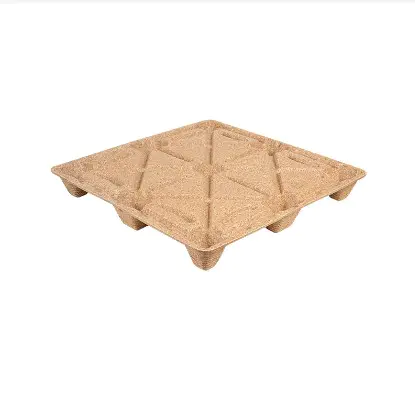
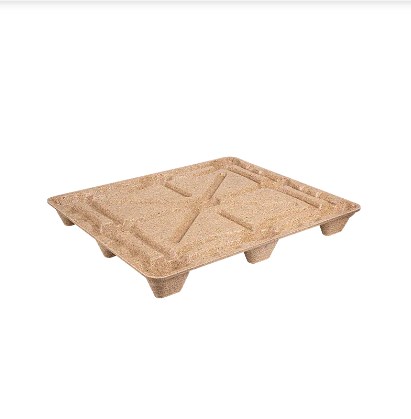
Environmentally friendly molded pallets represent a revolutionary, high-performance alternative to traditional wooden, plastic, and metal pallets, fully complying with global low-carbon and environmental protection standards. These pallets achieve 100% recyclability, degradability, and resource circularity, while delivering superior load-bearing capacity, durability, and safety performance. For logistics, warehousing, manufacturing, and international trade industries, adopting environmentally friendly molded pallets is the most practical and cost-effective path to building sustainable supply chains, reducing carbon emissions, and cutting long-term operational costs.
Unlike disposable or hard-to-recycle traditional pallets, eco-friendly molded pallets are produced from renewable biomass materials or recycled industrial raw materials using one-step molding technology. They generate almost no waste or harmful substances during production, transportation, and disposal, making them a core green packaging device recognized by international environmental organizations. Market application data shows that enterprises using this type of pallet can reduce their supply chain environmental impact by more than half while improving logistics efficiency and product protection, creating dual value for economic and environmental benefits.
Raw Material Composition of Environmentally Friendly Molded Pallets
The core environmental advantage of molded pallets comes from their exclusive raw material system, which abandons non-renewable or highly polluting materials and focuses on renewable, recyclable, and low-carbon raw materials. All raw materials meet global environmental certification requirements and do not contain toxic additives, heavy metals, or harmful chemicals, making them safe for food, pharmaceutical, and electronic product transportation.
Renewable Biomass Raw Materials
Most high-performance, environmentally friendly molded pallets use natural biomass as the main raw material, including plant fibers, agricultural waste, wood flour, bamboo powder, and straw. These materials are widely sourced, naturally degradable, and do not require deforestation, effectively reducing pressure on forest resources. Biomass-based molded pallets can completely degrade in natural soil within 12 months, leaving no white pollution or long-term ecological damage.
Recycled Polymer Composite Materials
Industrial-grade, environmentally friendly molded pallets are made from recycled plastic particles, recycled fiber composites, and waste industrial packaging materials. This production method realizes resource recycling, reduces the consumption of new plastic raw materials, and lowers carbon emissions generated by raw material extraction and processing. Recycled composite pallets can be recycled and remolded more than 10 times, maximizing resource utilization efficiency.
Environmentally Friendly Binding and Reinforcing Agents
To ensure structural strength and stability, non-toxic, water-based, and pollution-free binding agents are used in the molding process. These agents do not release volatile organic compounds (VOCs), comply with EU and US environmental safety standards, and are suitable for closed warehouses, cold chain logistics, and food-grade transportation scenarios without any safety risks.
Production Process and Environmental Performance of Green Molded Pallets
The production process of environmentally friendly molded pallets adopts automated, low-energy, and zero-emission molding technology, which is completely different from the high-pollution and high-energy-consumption processes of traditional pallets. The entire production chain meets green manufacturing standards and has become a model for sustainable production in the logistics and packaging industry.
One-Step Compression Molding Technology
The core production process is one-step hot compression molding, which mixes raw materials evenly and then forms them directly through high-precision molds. This process eliminates cutting, nailing, painting, and other processing procedures, reducing production energy consumption by more than 30% compared with plastic pallet injection molding, and does not produce dust, wastewater, or waste gas. The production line has high automation, short cycles, and high consistency, ensuring stable product quality and dimensional accuracy.
Low-Carbon and Zero-Pollution Production Characteristics
- No waste water discharge in the production process, all cooling systems use closed circulation
- No waste gas or harmful smoke emissions, complying with global industrial emission standards
- Production waste and defective products can be directly recycled and remolded, achieving zero solid waste discharge
- Low power consumption per unit product, greatly reducing the carbon footprint of the production stage
Quality Control and Environmental Certification System
Formal, environmentally friendly molded pallets must pass strict environmental and safety certifications, including ISO 14001 environmental management system, food contact safety certification, and recyclable packaging certification. The production process implements full-process quality monitoring to ensure that each pallet meets environmental performance, mechanical performance, and service life requirements, providing a reliable guarantee for enterprise use.
Core Performance Advantages of Environmentally Friendly Molded Pallets
In addition to outstanding environmental performance, green molded pallets have obvious performance advantages over traditional pallets, solving the pain points of low durability, poor stability, and high loss rate of wooden and plastic pallets, and significantly improving the safety and efficiency of logistics operations.
Excellent Physical and Mechanical Properties
The one-piece molding structure gives the pallet uniform stress distribution and strong overall load-bearing capacity. The static load can reach more than 3 tons, and the dynamic load exceeds 1 ton, meeting the needs of heavy-duty warehousing and logistics transportation. The pallet has high impact resistance, is not easy to crack or deform, and maintains stable performance in long-term high-frequency use.
Moisture, Corrosion, and Pest Resistance
Unlike wooden pallets, which are prone to moisture, mold, and insect damage, environmentally friendly molded pallets have a dense surface structure, are waterproof and moisture-proof, and do not absorb water or deform in humid, cold chain, or outdoor environments. They are resistant to chemical corrosion and suitable for use in chemical, electronic, and pharmaceutical industries, effectively extending the service life and reducing replacement frequency.
Light Weight and High Structural Stability
Under the same load-bearing capacity, green molded pallets are 20% to 30% lighter than wooden pallets and 40% lighter than metal pallets, which can reduce the overall weight of transportation vehicles, lower fuel consumption and carbon emissions during transportation, and reduce logistics costs. The integrated structure has no nails, gaps, or burrs, avoiding damage to goods and packaging, and improving transportation safety.
Long Service Life and Low Loss Rate
The average service life of environmentally friendly molded pallets is more than 5 years, which is 3 to 5 times that of ordinary wooden pallets. The loss rate is extremely low in normal use, and there is no need for frequent maintenance or replacement, which greatly reduces the pallet procurement and maintenance costs of enterprises in the long run.
Comparison Between Environmentally Friendly Molded Pallets and Traditional Pallets
To more intuitively reflect the advantages of green molded pallets, we compare them with three mainstream traditional pallets in terms of environmental performance, physical properties, cost, and application scope. The data comes from actual market application tests and industry research reports.
Table: Comprehensive Performance Comparison Between Environmentally Friendly Molded Pallets and Traditional Pallets
| Performance Item |
Eco-Friendly Molded Pallets |
Wooden Pallets |
Plastic Pallets |
| Environmental Performance |
100% Recyclable & Degradable |
Non-degradable, Deforestation |
Hard to Recycle, White Pollution |
| Service Life |
3-5 Years |
6-12 Months |
1-2 Years |
| Weight |
Light Weight |
Medium Weight |
Heavy Weight |
| Moisture Resistance |
Excellent |
Poor |
Good |
| Long-Term Cost |
Lowest |
Highest |
Medium |
The comparison results clearly show that environmentally friendly molded pallets are fully ahead of traditional pallets in all key indicators, especially in environmental protection and long-term cost control, which can bring sustained and stable value to enterprise operations.
Wide Application Fields of Environmentally Friendly Molded Pallets
Due to their strong environmental performance, high safety, and stable physical properties, green molded pallets are widely used in various industries and have become the preferred loading device for building sustainable supply chains. Their application scope covers almost all links of modern logistics and warehousing.
Food and Beverage Industry
Food-grade, environmentally friendly molded pallets are non-toxic, odorless, and easy to clean, meeting strict food safety standards. They are suitable for grain, beverages, frozen food, and aquatic product transportation, avoiding cross-contamination and ensuring the hygiene and safety of food throughout the supply chain.
Pharmaceutical and Medical Industry
Pharmaceutical products have high requirements for packaging, environmental protection, and cleanliness. Molded pallets have a smooth surface, no bacteria retention, and are resistant to disinfection and sterilization, making them ideal for pharmaceutical raw material storage, finished product transportation, and medical equipment logistics.
Electronics and Home Appliance Industry
Electronic products and home appliances are fragile and require high pallet stability. The integrated structure of molded pallets has no sharp parts, effectively protecting products from collision damage. At the same time, their anti-static properties can meet the transportation needs of precision electronic components.
International Trade and Cross-Border Logistics
Environmentally friendly molded pallets comply with international environmental import and export standards, do not require fumigation or quarantine inspection, greatly shortening customs clearance time and reducing trade barriers. They are widely used in sea, land, and air cross-border transportation and are recognized by global trade enterprises.
Warehousing, Retail, and E-Commerce Logistics
Large warehouses, supermarket chains, and e-commerce distribution centers have a high demand for pallets. Lightweight and durable molded pallets adapt to high-frequency handling and three-dimensional storage scenarios, improving warehousing space utilization and logistics distribution efficiency.
Economic and Social Value of Adopting Green Molded Pallets
The promotion and use of environmentally friendly molded pallets are not only conducive to environmental protection but also create significant economic benefits for enterprises and positive social value for the whole society, promoting the coordinated development of economy, society, and ecology.
Reduce Long-Term Operating Costs for Enterprises
Although the initial procurement cost of green molded pallets is slightly higher than that of wooden pallets, their long service life, low loss rate, and low maintenance cost make the comprehensive use cost more than 40% lower than that of wooden pallets in 3 years. In addition, lightweight pallets reduce transportation fuel consumption, and environmental advantages help enterprises obtain green supply chain certification and improve market competitiveness.
Promote the Development of the Circular Economy
The production and use system of molded pallets realizes the closed-loop cycle of "raw material collection - production - use - recycling - remolding", reducing the dependence on natural resources and industrial waste emissions. This model is in line with the national circular economy development strategy and promotes the transformation of the logistics industry from extensive to green and intensive.
Reduce Carbon Emissions and Fulfill Environmental Responsibilities
The entire life cycle of environmentally friendly molded pallets has low carbon emissions: renewable raw materials reduce carbon input, low-energy production reduces carbon emissions, lightweight transportation reduces fuel carbon output, and recycling reduces landfill carbon pollution. Enterprises using this pallet can reduce their carbon footprint by more than 50%, fulfilling their social responsibilities for carbon neutrality and carbon peaking.
Improve Industrial Image and Market Reputation
Consumers and partners pay increasing attention to the environmental behavior of enterprises. Using green molded pallets shows the enterprise's commitment to environmental protection, enhances brand image and social reputation, helps establish long-term trust with customers, and expands market share and cooperation space.
Future Development Trend of Environmentally Friendly Molded Pallets
With the global promotion of sustainable development strategies and the continuous improvement of logistics, packaging, and environmental protection standards, environmentally friendly molded pallets will become the mainstream of the pallet market and gradually replace traditional pallets, showing clear development trends in technology, materials, and applications.
Technological Innovation and Performance Upgrade
Future molded pallet technology will develop towards higher strength, lighter weight, and smarter production. New composite materials and molding processes will further improve load-bearing capacity and durability while reducing production costs and making products more cost-effective.
Wider Market Popularity and Application
Driven by national environmental policies and industry standards, more industries will mandatorily use green pallets. The global market demand for environmentally friendly molded pallets will maintain double-digit growth year by year, and their application will cover more emerging fields such as new energy, aerospace, and cold chain logistics.
Integration with Intelligent Logistics Systems
Green molded pallets will be combined with the Internet of Things, radio frequency identification, and other technologies to realize intelligent tracking, inventory management, and supply chain visualization. Intelligent molded pallets will become important carriers of modern intelligent logistics, improving the overall efficiency of the supply chain.
Global Standardization and Certification Unification
International organizations will unify the environmental protection and performance standards of molded pallets, forming a global unified certification system. This will further promote the circulation of pallets in cross-border trade and accelerate the globalization of the green pallet market.
Summary and Practical Guidance for Using Environmentally Friendly Molded Pallets
Environmentally friendly molded pallets are the best sustainable solution for the modern logistics and warehousing industry, integrating environmental protection, high performance, economy, and safety. They solve the environmental pollution and resource waste problems of traditional pallets while improving logistics efficiency and reducing operating costs, creating dual value for enterprises and the environment.
For enterprises planning to adopt green molded pallets, practical suggestions are as follows: choose raw materials and specifications matching their own industry needs, give priority to products with formal environmental certifications, calculate long-term comprehensive costs instead of short-term procurement costs, and establish a pallet recycling and management system to maximize resource utilization. With the continuous advancement of global green development, environmentally friendly molded pallets will become an indispensable core piece of equipment in the logistics industry, leading the transformation and upgrading of the global packaging and logistics industry.
 English
 Français
 Español
 عربى
عربى