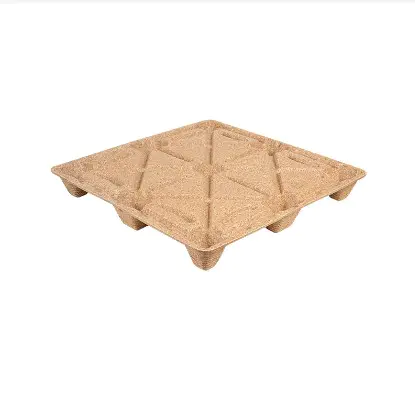
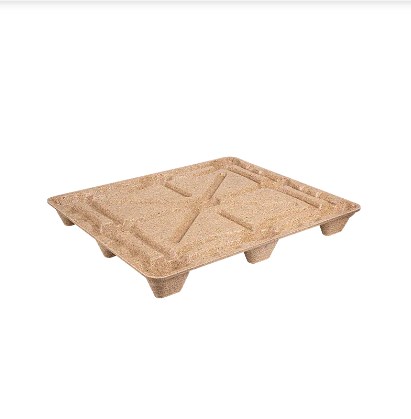
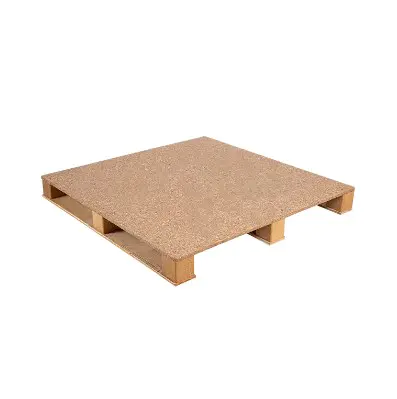
Reducing pallet weight can lower material consumption, simplify handling and decrease the amount of packaging mass transported with every shipment. But for molded wood pallets, lightweighting is not simply a matter of using less fiber. Remove material from the wrong location, and the result may be excessive deck deflection, weak feet, damaged fork-entry areas or reduced stacking performance.
The engineering challenge is therefore more precise: manufacturers need to eliminate unnecessary mass while preserving the material and structural support required in high-stress areas. Mold geometry, density distribution, wood-particle preparation, binder dosage, charge weight and hot-press parameters all contribute to the final strength-to-weight balance.
Core principle: The objective is not to manufacture the lightest possible pallet. It is to manufacture the lightest pallet that consistently meets the performance requirements of its intended logistics application.
Pallet Weight Is an Engineering Target, Not Just a Material-Saving Goal
Every kilogram added to a pallet has consequences. More weight normally means more wood fiber and binder, additional material cost and more packaging mass moving through the supply chain. For shipments that approach truck or container payload limits, pallet tare weight can also reduce the amount of saleable cargo that can be carried.
The opposite extreme creates a different problem. A pallet that has been aggressively lightened may still look acceptable while showing excessive bending under load, local weakness around the feet or insufficient resistance to repeated forklift handling.
This is why molded pallet development increasingly focuses on strength-to-weight efficiency rather than weight alone. Manufacturers determine the structural performance required for the application and then work backward to optimize material use.
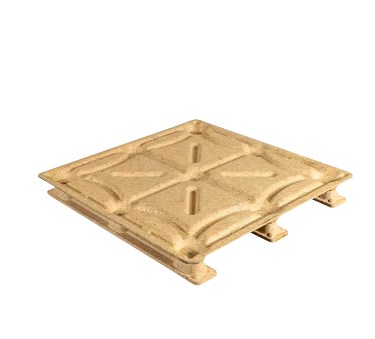
Too Heavy Higher material consumption Higher transport mass Potentially unnecessary density
OPTIMIZE
Too Light Higher deflection risk Weak local structures Reduced handling durability
The correct design also depends on how the pallet will be supported. A pallet resting fully on the floor experiences different stresses from one supported on warehouse rack beams or handled repeatedly by forklifts. For this reason, weight reduction should always be evaluated against defined loading and handling conditions.
Mold Geometry Determines Where Material Is Actually Needed
One of the important characteristics of molded wood pallet manufacturing is that the pallet can be formed as an integrated three-dimensional structure. Instead of relying only on uniform boards and blocks, engineers can create ribs, feet, curved transitions and reinforced fork-entry zones directly in the mold.
This makes it possible to place more material where structural demand is high and reduce unnecessary material where stresses are lower.
| Pallet Area |
Primary Mechanical Demand |
Typical Weight-Control Strategy |
| Deck center |
Bending and distributed cargo load |
Use ribs or contours to increase stiffness without uniformly increasing thickness |
| Feet |
Compression, stacking and local impact |
Maintain sufficient local material and density |
| Fork-entry areas |
Repeated handling and impact |
Reinforce geometry around contact zones |
| Corners |
Handling impact and local stress |
Maintain controlled thickness and smooth transitions |
| Low-stress surfaces |
Limited structural demand |
Remove unnecessary volume where testing confirms it is safe |
Ribs Can Add Stiffness Without Adding Full-Deck Thickness
Increasing the thickness of an entire pallet deck is a simple way to add material, but it is rarely the most efficient way to increase stiffness. Properly positioned ribs can increase the section depth of the structure and improve resistance to bending while concentrating material along important load paths.
The same principle is widely used in molded industrial components: geometry does part of the structural work so that material does not have to do all of it through mass alone.
Feet and Transition Zones Cannot Be Lightened Indiscriminately
Pallet feet carry concentrated loads and transfer those loads into the deck. The areas connecting feet, ribs and the main deck can therefore experience high local stresses.
If lightweighting creates abrupt thickness changes or insufficient material around these transitions, the pallet may develop weak zones even if its average density remains acceptable. Rounded transitions, adequate radii and controlled local reinforcement can help distribute stress more effectively.
Design lesson: Removing 500 grams from a low-stress deck area may have very little effect on performance. Removing the same amount from a critical foot or rib transition can have a much larger structural consequence.
Density Control Is Just as Important as Pallet Geometry
Pallet weight is closely related to molded volume and material density. Even when two pallets come from the same mold, changes in charge weight, moisture, particle packing or pressing behavior can produce different finished weights.
Higher density often improves particle contact and can increase structural stiffness, but maximizing density is not automatically desirable. Excessive density increases raw-material consumption and pallet mass and may provide little additional value once the required performance has already been achieved.
At the other end of the range, insufficient density can result in excessive porosity, poor local bonding, higher deflection and reduced resistance to impact.
Weight Optimization Principle Target the lowest stable density that repeatedly satisfies the pallet's required structural performance.
Average Density Does Not Tell the Whole Story
Two pallets can have exactly the same finished weight but perform differently because their material is distributed differently.
Consider two pallets of equal mass. In the first, sufficient material is concentrated around the feet, ribs and other load-bearing structures. In the second, excess material remains in low-stress areas while the feet are relatively under-filled. The scales show the same number, but their structural efficiency is different.
For this reason, manufacturers need to control both overall density and local density distribution. Consistent mold charging, particle flow and pressing are essential to achieving this balance.
Particle Size Affects How Efficiently Material Can Be Used
Recycled wood residues used for molded pallets can contain particles of different sizes and shapes. That distribution affects how easily the material fills the mold, how densely particles pack together and how much binder is required to create a stable structure.
Oversized Particles Can Make Thin Sections Difficult to Fill
Large particles may not distribute easily into narrow ribs, corners or deep molded features. Poor filling can create voids or low-density areas, leading manufacturers to compensate by increasing the overall charge weight. That adds mass without necessarily solving the real problem.
Excessive Fines Can Increase Binder Demand
Very fine particles have a high surface area relative to their mass. When the proportion of fines increases significantly, adhesive demand and processing behavior may change. A formulation designed for one particle distribution may therefore become less efficient if the feedstock shifts toward much finer material.
| Feedstock Condition |
Possible Manufacturing Effect |
Possible Weight Consequence |
| Too many oversized particles |
Poor filling in detailed areas |
Extra charge may be used to compensate |
| Excessive fines |
Higher surface area and different binder demand |
Potential increase in resin or density |
| Highly variable particle mix |
Changing bulk density between batches |
Finished pallet weight becomes less stable |
| Controlled particle distribution |
More predictable filling and compaction |
More stable charge and finished weight |
The goal is therefore not to identify one universal particle size for every molded pallet. Manufacturers establish a particle-size distribution that works with the specific mold geometry, binder system, press conditions and required pallet performance.
Binder Optimization Can Reduce Mass—But Too Little Creates False Savings
Adhesive also contributes to the total pallet mass and cost. Reducing binder dosage may appear to be an easy lightweighting strategy, but the relationship between binder content and performance is not linear.
If binder levels fall below the validated processing range, manufacturers may see reduced internal bonding, greater sensitivity to moisture, weaker impact performance or increased scrap rates. Any small material saving can quickly disappear if more pallets fail inspection or perform poorly in service.
Better Distribution Can Be More Valuable Than More Adhesive
A common process challenge is uneven binder distribution. Some areas of the fiber mixture can become resin-rich while others receive insufficient adhesive. Increasing the total binder dosage may partially hide the problem, but it does not solve the underlying lack of uniformity.
More consistent fiber moisture, controlled particle distribution, stable adhesive viscosity and effective mixing can allow manufacturers to achieve reliable bonding without using excessive resin as a safety margin.
Material efficiency does not come only from reducing specifications. Improving process consistency can reduce the need for excess fiber and binder that were previously added to compensate for production variation.
Charge Weight Control Prevents Both Overweight and Weak Pallets
Before hot pressing, a measured quantity of prepared fiber and binder is introduced into the mold. This is commonly referred to as the charge. The consistency of this charge has a direct influence on finished pallet weight.
An excessive charge can produce an overweight pallet, increase material consumption and contribute to flash around mold parting areas. An insufficient charge can create incomplete filling, thin ribs, weak feet or low-density zones.
Feedstock Preparation → Binder Mixing → Measured Charge → Hot Pressing → Finished Pallet Weight
Weight-based dosing is particularly useful when recycled fiber is involved because bulk density can change between material batches. A hopper volume that contained a given mass yesterday may contain a different mass today if particle size, moisture or compaction changes.
Finished Pallet Weight Is Also a Production Signal
Manufacturers can use finished weight as more than a product specification. It can function as an early process-control indicator.
If pallets from the same mold gradually become heavier, the cause may include increasing charge weight, changing moisture, different feedstock bulk density or higher binder addition. If weight variability suddenly increases, it can indicate that upstream material preparation has become less stable.
| Weight Trend |
Possible Area to Investigate |
| Average weight gradually increasing |
Charge settings, moisture, binder dosage or feedstock density |
| Average weight gradually decreasing |
Undercharging, material-flow changes or dosing calibration |
| Weight variation increasing |
Feedstock consistency, moisture variation or dosing instability |
| Correct weight but weaker test results |
Density distribution, bonding or press conditions rather than total mass |
Hot Pressing Determines Whether Less Material Can Still Perform Reliably
Lightweight design depends on a stable molding process. Even a well-designed pallet with carefully prepared material can lose performance if pressure, temperature or curing time varies beyond the validated production window.
Pressure
Controls consolidation, particle contact and final structural density. Insufficient pressure may leave poorly consolidated regions.
Temperature
Influences binder curing, wood-fiber behavior and moisture movement during the molding cycle.
Dwell Time
Provides time for consolidation and adhesive cure. Insufficient time can leave internal bonding incomplete.
Moisture
Interacts with heat transfer, fiber plasticization and vapor generation during pressing.
This relationship explains why material reduction should usually follow process stabilization rather than precede it. If a manufacturer reduces charge weight before moisture, temperature and dosing are under control, natural production variation may push some pallets below the required performance threshold.
A more reliable approach is to establish a stable baseline, reduce weight in controlled steps, test the resulting pallet and identify the point at which further material reduction begins to compromise stiffness, durability or handling performance.
How Manufacturers Verify That a Lighter Pallet Is Still Strong Enough
A lighter design should not be approved on appearance or calculated weight savings alone. Performance must be verified on the finished pallet under loading conditions representative of the intended application.
ISO 8611-1:2025 provides test methods for evaluating new flat pallets and groups those methods around nominal load testing, maximum working load testing and durability comparison. ISO 8611-2:2025 addresses performance requirements for establishing nominal loads and selecting tests for different handling environments.
The standards also reinforce an important engineering principle: laboratory load testing does not eliminate the value of validating a specific pallet design in its actual operating environment.
Dimensions
Verify overall size, foot geometry, fork openings and critical molded features.
Finished Weight
Confirm that production remains within the defined manufacturing range.
Bending & Deflection
Evaluate how the pallet behaves under relevant support and payload conditions.
Compression
Check load transfer through decks, feet and stacking structures.
Dynamic Handling
Evaluate repeated forklift entry, movement and practical handling stresses.
Durability
Determine whether repeated handling changes pallet performance over time.
Every Weight-Reduction Change Has a Performance Variable That Must Be Rechecked
| Optimization Change |
What Should Be Revalidated? |
| Reduce deck thickness |
Bending stiffness and deflection |
| Reduce total charge weight |
Overall load performance and mold filling |
| Change rib geometry |
Local stresses and deck stiffness |
| Reduce binder dosage |
Internal bonding and moisture performance |
| Reduce average density |
Impact, compression and handling durability |
| Change particle distribution |
Filling consistency, strength and production variation |
This is also why pallet load ratings should not be interpreted without context. Static loading, dynamic handling and supported or racked conditions can impose very different demands on the same pallet.
Lower Pallet Weight Can Reduce Costs Beyond Raw Materials
Once the required strength has been preserved, lower pallet weight can generate benefits beyond simply saving wood fiber.
More Payload May Be Available in Weight-Limited Shipments
Consider an illustrative shipment using 1,000 pallets. If engineering optimization reduces each pallet by 2 kg without changing its required performance, the shipment carries 2,000 kg less pallet tare mass.
That does not automatically produce a freight saving. If the truck or container reaches its volume limit long before its payload limit, the benefit may be limited. But in weight-constrained shipments, lower pallet tare weight can leave more capacity available for commercial cargo.
Lower Mass Can Simplify Empty-Pallet Handling
Weight also affects movements before and after the pallet carries cargo. Large logistics operations may handle thousands of empty pallets between production lines, warehouses and staging areas. Reducing unnecessary mass can improve material-handling efficiency when repeated across large pallet volumes.
Material Efficiency Supports a More Resource-Efficient Product
Using less fiber and binder for the same required logistics function can also improve material efficiency. However, this advantage only exists if the lighter pallet maintains its intended performance and does not increase damage or premature replacement.
Illustrative Weight-Saving Calculation
2 kgWeight reduction per pallet
1,000Pallets shipped
2,000 kgLess packaging mass moved
This example illustrates the effect of pallet tare weight only. Actual freight savings depend on payload limits, shipment volume, pallet dimensions and transport configuration.
The Goal Is Not the Lightest Pallet—It Is the Most Efficient Pallet
Weight optimization in molded wood pallet manufacturing is ultimately an exercise in structural efficiency. Manufacturers cannot achieve reliable lightweighting by simply removing fiber or lowering binder dosage across the entire product.
Instead, successful designs coordinate mold geometry, rib placement, local density, particle distribution, adhesive control, charge weight and hot-press conditions. Material is preserved around critical load-bearing regions and reduced only where engineering analysis and testing show that it is unnecessary.
The result should not be judged by pallet weight alone. A genuinely efficient pallet uses the minimum practical amount of material while continuing to provide the dimensional stability, load performance and handling durability required by the logistics system.
Evaluating Molded Wood Pallet Weight and Load Requirements?
Ronsun Import & Export Co., Ltd. supplies molded wood pallet solutions for industrial logistics, warehousing and international shipping. Pallet specifications can be evaluated according to dimensions, cargo weight, handling methods, storage conditions and application requirements.
Frequently Asked Questions
Does a lighter molded wood pallet automatically have lower strength?
No. Pallet performance depends on structural geometry, local density, fiber distribution, binder performance and manufacturing conditions. A lighter pallet with efficient ribs and properly reinforced load-bearing areas can perform differently from a heavier design that uses material less efficiently.
What determines the weight of a molded wood pallet?
Important factors include pallet dimensions and geometry, molded density, fiber charge weight, moisture content, binder dosage and material distribution throughout the mold.
Can manufacturers simply reduce the amount of wood fiber to make a pallet lighter?
Reducing fiber without redesign and testing can create incomplete filling, low-density areas, excessive deflection or weak feet and ribs. Weight reduction should be carried out in controlled steps and followed by dimensional and performance validation.
How do ribs help reduce molded pallet weight?
Ribs increase structural depth and stiffness in selected areas, allowing manufacturers to reinforce important load paths without making the entire pallet deck uniformly thicker.
Why can two molded wood pallets with the same weight have different strength?
Total mass does not show where the material is located. Differences in local density, rib geometry, binder distribution, particle packing and press conditions can produce significantly different structural performance at the same finished weight.
How should buyers compare pallet weight and load capacity?
Buyers should consider the stated load condition, pallet support method, deflection, handling environment and durability rather than comparing only pallet mass against one headline load figure. Static, dynamic and racking conditions can place very different demands on the pallet.
 English
 Français
 Español
 عربى
عربى