English
 Français
 Español
 عربى
Molded wood pallet quality begins long before the material enters the hot press. The size, shape and distribution of wood particles influence how the raw material packs inside the mold, how adhesive is distributed and how the structure consolidates under heat and pressure. These factors can affect the finished pallet's surface appearance, density uniformity and mechanical performance.
For industrial pallet buyers, particle size may seem like a minor manufacturing detail. However, it helps explain why pallets with similar dimensions and nominal weights can show differences in surface texture, local strength and production consistency. Understanding the relationship between wood particle preparation and molded pallet performance provides a more useful basis for evaluating product quality.
Why Particle Size Matters in Molded Wood Pallet Manufacturing
Molded wood pallets are manufactured by consolidating prepared wood-based material with a suitable binder under heat and pressure. Depending on the manufacturing system, the raw material may contain wood fibers, particles, flakes or a combination of differently sized components.
Four characteristics are particularly relevant to material preparation:
- Particle size: The dimensions of individual wood particles.
- Particle shape: Whether particles are relatively elongated, flat, irregular or compact.
- Aspect ratio: The relationship between particle length and thickness or width.
- Particle size distribution: The proportion of different particle sizes within the complete material mixture.
Particle size distribution is often more useful than a single average particle size. Two material batches may have similar average dimensions while containing very different proportions of fine particles and oversized fragments.
These differences can change material packing, adhesive coverage and consolidation behavior during molding.
Fine Wood Particles vs Coarse Wood Particles
Fine and coarse wood particles behave differently during preparation and pressing. Neither category is universally superior because each affects several manufacturing variables simultaneously.
Fine Wood Particles
Smaller particles generally provide greater surface area per unit mass. Under suitable manufacturing conditions, they can help create relatively smooth surfaces and fill spaces between larger particles.
However, increasing the proportion of fines can also change adhesive requirements, bulk density and material handling behavior. If the binder formulation is not adjusted appropriately, the available adhesive may become insufficient for consistent coverage.
Coarse Wood Particles
Larger particles can contribute to the internal structure of a wood-based composite, depending on their shape, orientation and bonding quality.
However, excessive coarse material may create visible surface texture, uneven local packing or difficulties in filling narrow mold regions.
| Factor | Fine Particles | Coarse Particles |
|---|---|---|
| Surface area per unit mass | Generally higher | Generally lower |
| Surface appearance | Can support smoother surfaces | May create more visible texture |
| Binder coverage | May require greater coverage area | Depends on particle geometry |
| Packing behavior | Can fill smaller spaces | Influences the main particle structure |
| Mechanical performance | Requires formulation optimization | Requires formulation optimization |
| Mold filling | Influenced by fines content and flow behavior | May be more sensitive to narrow features |
The objective is therefore not to maximize the percentage of fine particles. Manufacturers need a particle mixture that supports the required pallet geometry, bonding quality and structural performance.
How Particle Size Distribution Affects Material Packing Density
Particle packing describes how wood particles occupy space before and during consolidation. It influences the amount and distribution of void space within the material.
Particle Packing and Void Formation
When particles are distributed unevenly, some regions may contain relatively large voids while others become densely packed. Under pressing pressure, these regions may respond differently.
An appropriate combination of particle sizes can allow smaller particles to occupy some of the spaces between larger components. However, this relationship is not unlimited. Excessive fines can change material flow, binder distribution and consolidation behavior.
Density Uniformity Across the Pallet
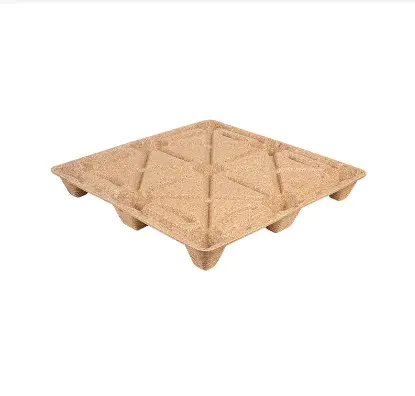
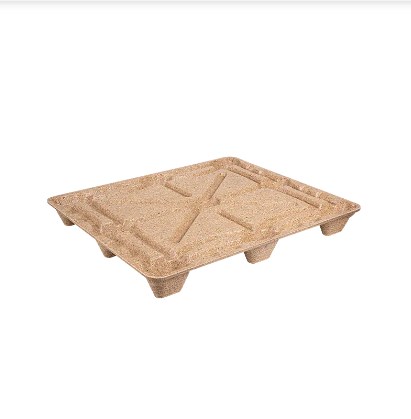
A molded pallet is not a simple flat board. Its structure may include a broad deck, reinforcing ribs, integrated feet and transitions between thick and thin sections.
These features can create different local material distribution and compression conditions.
For example, a pallet foot must transfer concentrated loads to the supporting surface, while the deck distributes cargo weight across a larger area. Both regions need suitable material consolidation, but their geometry and local stresses differ.
Consistent particle preparation helps reduce one source of variation in this process. Final density uniformity also depends on material placement, mold geometry, charge weight and pressing conditions.
Why Particle Size Influences Binder Distribution
Binder distribution is another important connection between particle preparation and finished pallet quality.
Surface Area and Adhesive Coverage
Fine particles generally expose more total surface area than coarse particles of the same mass. This can influence the amount of adhesive needed to achieve suitable bonding.
If a formulation is changed to include more fines without considering adhesive coverage, the resulting bond quality may differ from the original design.
Mixing Uniformity
Particle size distribution can also influence how materials move through mixing equipment. Uneven blending may create areas with different binder concentrations.
The resulting differences may affect internal bonding, surface quality and mechanical consistency.
Binder Consumption and Manufacturing Cost
Adhesive is an important manufacturing cost component. However, binder consumption cannot be predicted from particle size alone.
Relevant factors include:
- Wood species and particle geometry
- Binder chemistry and solids content
- Particle moisture content
- Mixing and application methods
- Target density and mechanical properties
- Pressing and curing conditions
How Particle Size Affects Molded Pallet Surface Quality
Surface appearance is one of the first characteristics buyers notice when inspecting molded wood pallets.
Although appearance alone cannot establish structural performance, it can provide useful information about manufacturing consistency.
Surface Smoothness
A suitable proportion of smaller particles can help create a more uniform surface under appropriate molding conditions.
The final result also depends on mold finish, material moisture, binder distribution and pressing parameters.
Surface Voids
Visible voids may occur when material packing or consolidation is insufficient. Particle size distribution can contribute to this problem, but it is not the only possible cause.
Edge Definition
Molded pallets may contain curved transitions, reinforced corners and integrated structural features. Material preparation can influence how consistently these regions are formed.
Batch-to-Batch Appearance
Changes in raw material preparation may produce visible differences between production batches, even when the pallet mold and nominal specifications remain unchanged.
| Surface Observation | Possible Material-Related Factor | Additional Factors to Check |
|---|---|---|
| Rough surface | High coarse-particle fraction | Mold condition and pressing |
| Visible voids | Uneven particle packing | Charge distribution and consolidation |
| Uneven texture | Variation in particle distribution | Mixing and material moisture |
| Poor edge definition | Unsuitable material distribution | Mold geometry and pressing conditions |
| Local density variation | Uneven particle packing | Material placement and compression |
These observations should be treated as inspection indicators rather than definitive diagnoses. Identifying the actual cause requires appropriate production records and testing.
How Particle Size Influences Pallet Strength
Mechanical performance depends on how effectively the molded structure transfers loads through its bonded wood-based material.
Particle size and shape influence this behavior, but their effects cannot be separated from binder quality, density and pallet geometry.
Internal Bonding
Strong internal bonding requires suitable contact between particles and effective adhesive distribution. Excessive voids or inconsistent binder coverage may reduce local structural reliability.
Bending Behavior
During forklift handling or other supported loading conditions, the pallet deck may experience bending.
Particle geometry and bonding can influence stiffness, stress transfer and fracture behavior. However, the relationship is not simply that smaller particles produce higher bending strength.
Local Compression
Integrated pallet feet and other concentrated support regions must resist local compression.
Their performance depends on local density, geometry, bonding and the way cargo weight is distributed through the pallet structure.
Why Maximum Density Is Not the Only Objective
Increasing density may improve some mechanical properties within a particular material system, but it also affects pallet weight, material consumption, production requirements and cost.
A heavier pallet is not automatically a better pallet.
Manufacturers should therefore optimize the material structure for the intended loading and handling conditions rather than maximizing one material parameter in isolation.
How Screening and Particle Classification Improve Production Consistency
Raw material preparation can reduce variation before the molding process begins.
Particle Screening
Screening separates material according to particle size. It can help manufacturers maintain a more controlled distribution and identify material outside the desired range.
Oversized Particle Control
Excessively large particles may create problems in narrow mold features or produce irregular surface characteristics.
Removing or reprocessing unsuitable oversized material can improve consistency where required by the manufacturing formulation.
Excessive Fines Control
Very fine particles can affect binder coverage, mixing and material handling. Their proportion should be controlled according to the selected production process.
Batch Consistency
Different raw material batches may vary in particle size, moisture and wood composition.
Manufacturers may use screening analysis, sampling, moisture measurement and other process controls to monitor these differences.
The appropriate control method depends on the equipment, feedstock and quality requirements.
Why Mold Geometry Changes Particle Size Requirements
Molded wood pallets contain structural features that make material distribution more complex than manufacturing a uniform flat panel.
Deck Areas
Broad surfaces require suitable material distribution and consistent consolidation across the cargo-supporting area.
Reinforcing Ribs
Narrow structural features may be sensitive to particle geometry and material placement.
Integrated Feet
Load-bearing feet require appropriate local density, bonding and dimensional consistency.
Curved Transitions
Changes in section thickness can influence local material distribution and compression behavior.
A particle formulation suitable for one molded product cannot automatically be transferred to every pallet design.
The relationship between mold geometry, particle distribution, binder system and pressing conditions must be considered as a complete manufacturing process.
Balancing Strength, Weight and Surface Quality for Different Applications
Different industrial applications place different demands on molded wood pallets.
Export Packaging
Exporters often require suitable load performance, consistent dimensions and efficient pallet weight. The material formulation should support these requirements without unnecessary material consumption.
Automated Warehousing
Automated handling may require tighter control of pallet dimensions, foot geometry, flatness and stiffness. Raw material consistency contributes to repeatable production, although finished-pallet verification remains essential.
Heavy Industrial Cargo
Heavy machinery components and other concentrated loads require careful evaluation of deck support, local compression and load distribution.
| Design Priority | Particle-Related Consideration |
|---|---|
| Surface quality | Suitable fine/coarse particle balance |
| Load performance | Bonding and structural uniformity |
| Weight control | Density and material distribution |
| Dimensional consistency | Stable raw material preparation |
| Production efficiency | Screening, mixing and pressing compatibility |
There is no universal particle size distribution that provides the best result for every molded pallet application.
What Buyers Should Check When Evaluating Molded Wood Pallet Quality
Most pallet buyers do not need to specify the exact wood particle size used by the manufacturer.
Instead, purchasing specifications should focus on the finished pallet's required performance and consistency.
Surface Condition
Check visible voids, surface uniformity, edges and structural features.
Dimensions
Verify length, width, height and relevant foot geometry.
Structural Performance
Confirm load ratings and test conditions relevant to the application.
Batch Consistency
Evaluate variation in pallet weight, dimensions and appearance.
Handling Compatibility
Consider forklifts, conveyors, storage systems and cargo distribution.
Supplier Communication
Provide cargo weight, pallet dimensions, operating conditions and order requirements.
A useful purchasing discussion should begin with cargo weight, load distribution, handling methods, storage conditions and required pallet dimensions.
The manufacturer can then evaluate suitable materials and production parameters against those requirements.
Better Molded Pallets Start With Controlled Wood Particle Preparation
Molded wood pallet performance is influenced by more than the hot press or the finished pallet mold.
Wood particle size, shape and distribution affect material packing, binder coverage, consolidation, density uniformity and surface appearance. These factors can also contribute to differences in structural performance between production batches.
However, no single particle size provides the best combination of strength, weight and surface quality for every pallet design.
Reliable manufacturing requires the particle mixture, binder system, mold geometry and pressing conditions to work together.
For industrial buyers, the most practical approach is to evaluate the finished pallet against clear dimensional, loading and handling requirements while considering production consistency across repeated orders.
Looking for Consistent Molded Wood Pallet Solutions?
Ronsun Import & Export Co., Ltd. supplies molded wood pallet solutions for industrial packaging and logistics applications. Buyers can discuss pallet dimensions, cargo weight, handling requirements and order specifications when evaluating suitable molded wood pallet products.
Frequently Asked Questions
Does smaller wood particle size always improve molded pallet strength?
No. Strength depends on particle size distribution, particle shape, binder quality, density, mold geometry and pressing conditions. Finer particles may improve some characteristics while changing adhesive demand and consolidation behavior.
Why do some molded wood pallets have rough surfaces?
Rough surfaces may be associated with coarse particles, uneven material distribution, mold condition or pressing parameters. Surface appearance alone cannot identify the exact cause.
How does particle size affect binder consumption?
Smaller particles generally have greater surface area per unit mass, which can influence adhesive coverage requirements. Actual binder consumption also depends on particle geometry, wood species, adhesive chemistry and manufacturing conditions.
Can particle size distribution affect pallet weight?
Particle distribution can influence packing and consolidation, but finished pallet weight also depends on material charge, density, dimensions and moisture content.
Why is particle screening important in molded pallet production?
Screening helps control the proportion of different particle sizes and identify oversized material or excessive fines. This can support more consistent raw material preparation and production results.
Should buyers specify a particular wood particle size?
Most buyers should prioritize finished-pallet requirements such as dimensions, load performance, weight and handling compatibility. Particle size specifications are generally best established through manufacturer validation for the selected pallet design.