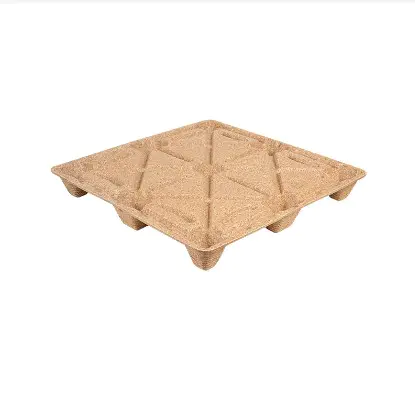
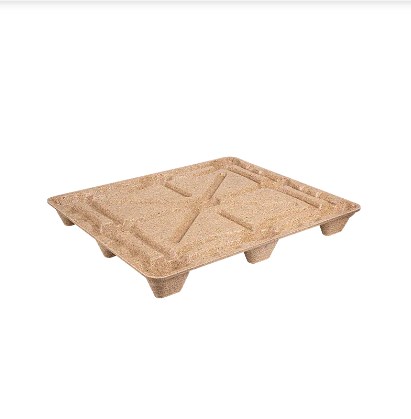
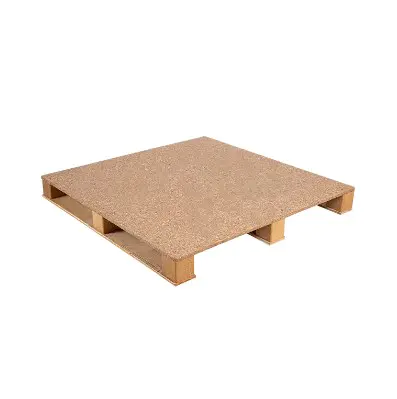
Choosing the right molded wood pallet size is not simply a matter of matching the length and width of an existing wooden pallet. The pallet footprint affects product fit, warehouse racking, forklift access, container utilization, pallet weight, nesting efficiency, and ultimately the total cost of the logistics system.
For importers, distributors, manufacturers, and warehouse operators, the most useful approach is to evaluate pallet dimensions together with load requirements and handling conditions.
As a supplier of molded wood pallets, Ronsun Import & Export Co., Ltd. provides standard and customized pallet solutions for international shipping, warehousing, manufacturing, food distribution, pharmaceutical logistics, and other industrial applications.
This guide explains the most common molded wood pallet sizes, how load ratings should be interpreted, what dimensions should be verified before ordering, and how pallet size affects container and trailer utilization.
Standard Molded Wood Pallet Sizes and Dimension Chart
Several pallet footprints have become widely used because they are compatible with common packaging modules, forklifts, warehouse systems, and international transportation equipment.
In the United States, 48 × 40 inches, approximately 1219 × 1016 mm, is one of the most familiar pallet footprints. International logistics also commonly uses 1200 × 1000 mm, 1200 × 800 mm, and 1100 × 1100 mm footprints. ISO publications recognize these major pallet dimensions for international materials handling.
The following table provides a practical purchasing reference.
| Nominal Pallet Size |
Approx. Inch Size |
Typical Market/Application |
Typical Overall Height |
Typical Empty Weight* |
| 1219 × 1016 mm |
48 × 40 in |
U.S. retail, grocery, general distribution |
120–150 mm |
14–20 kg |
| 1200 × 1000 mm |
47.2 × 39.4 in |
Industrial, chemical, manufacturing, export |
120–150 mm |
14–19 kg |
| 1200 × 800 mm |
47.2 × 31.5 in |
European distribution and export logistics |
120–150 mm |
11–16 kg |
| 1100 × 1100 mm |
43.3 × 43.3 in |
Asia-Pacific logistics, drums, bulk goods |
120–150 mm |
13–18 kg |
| 1140 × 1140 mm |
44.9 × 44.9 in |
Containerized goods, drums and industrial cargo |
130–155 mm |
15–20 kg |
| 1000 × 1000 mm |
39.4 × 39.4 in |
Industrial and customized unit loads |
120–150 mm |
11–16 kg |
| 1300 × 1100 mm |
51.2 × 43.3 in |
Larger industrial packages |
Model dependent |
Model dependent |
*Weights and heights are representative purchasing ranges rather than guaranteed specifications. Mold design, density, reinforcement and load class can change the final weight.
For molded pallets, buyers should not focus only on overall length and width. Other important dimensions include:
- overall pallet height;
- fork opening height and width;
- spacing between molded feet;
- deck thickness at critical load points;
- reinforcement rib geometry;
- nesting depth; and
- clearance required by pallet jacks or forklifts.
A dimensional tolerance of approximately ±3 to ±5 mm may be specified for many commercial applications, but the approved technical drawing should always control the final acceptance criteria.
Load Capacity: Static, Dynamic, Concentrated and Rack Loads
A pallet’s size does not automatically determine its load capacity.
Two molded wood pallets measuring 1200 × 1000 mm can have very different performance because of differences in material density, pallet weight, molded rib design, foot geometry and structural reinforcement.
The three most important load ratings are:
Static load refers to a pallet resting on a flat, stable floor without movement.
Dynamic load refers to the load supported while the pallet is being moved by a forklift or pallet truck.
Rack load describes performance when the pallet is supported only at defined points, such as across warehouse rack beams.
These ratings cannot be used interchangeably.
A pallet capable of carrying a heavy uniformly distributed load on the warehouse floor may not be suitable for unsupported beam racking.
Uniform Load vs. Concentrated Load
Load distribution also matters.
For example, 1,000 kg distributed evenly across cartons covering most of the pallet deck creates a very different stress pattern from a 1,000 kg machine concentrated on four small mounting feet.
When selecting a molded pallet, provide the supplier with:
- total product weight;
- number of cartons or containers;
- contact area between cargo and pallet;
- load center;
- stacking height;
- forklift handling method; and
- whether the pallet will be stored on the floor, conveyor or rack.
A typical industrial molded wood pallet may be designed for dynamic loads in the range of approximately 800–1,500 kg and substantially higher static loads, but the actual rating must be confirmed for the specific pallet model.
For high-value cargo, cold storage, automated handling systems or uncertain load distribution, a suitable engineering safety factor should also be applied.
Are Molded Wood Pallets Rackable?
Some are, but rackability should never be assumed from pallet size alone.
Rack-supported loads can create high bending stresses across the center of the pallet. A design intended primarily for floor stacking or forklift transportation may require additional reinforcement before it can safely span rack beams.
Before ordering, specify the rack beam spacing and the direction in which the pallet will be supported.
CAD Drawings, Technical Specifications and Dimension Verification
For repeat orders or automated warehouse applications, purchasing a pallet from only a nominal dimension such as “48 × 40” is risky.
A technical drawing should be approved before mass production.
Depending on the pallet model and project, engineering information may be supplied in formats such as:
- PDF dimensional drawing;
- DWG;
- DXF;
- STEP; or
- other CAD formats requested for engineering review.
The drawing should identify more than the outer dimensions.
Important measurements include overall length, overall width, overall height, fork-entry clearance, molded foot dimensions, foot spacing, deck profile, reinforcement positions and nesting dimensions.
Incoming Inspection Procedure
When a shipment arrives, warehouse staff can perform a simple dimensional inspection:
1. Select samples from different stacks.
Do not inspect only pallets from the top of one stack.
2. Measure length, width and height.
Use the tolerances shown on the approved drawing or purchase specification.
3. Measure both diagonals.
A significant difference can indicate distortion or dimensional instability.
4. Check fork openings.
Verify that the intended forklift and pallet-jack forks can enter without interference.
5. Inspect the molded structure.
Look for cracks, damaged feet, excessive warpage or incomplete molded areas.
6. Compare the result with the approved sample.
Any dimensional deviation affecting handling or product fit should be reviewed before the pallet is released into production.
CAD models can also be imported into warehouse-layout, packaging and container-loading software to confirm product fit before a large order is placed.
Selecting Pallet Size for Containers, Trucks and Warehouse Systems
Pallet size directly affects transportation efficiency.
A smaller pallet is not automatically more economical, because the wrong footprint may leave excessive unused floor area inside a container or trailer.
A larger pallet may reduce the number of handling units but increase unused space around the perimeter.
Before selecting the footprint, consider:
- carton dimensions;
- number of cartons per layer;
- allowable product overhang;
- container internal width;
- loading orientation;
- forklift clearance; and
- warehouse rack dimensions.
For U.S. domestic distribution, 48 × 40-inch pallets are often convenient because many packaging and handling systems are designed around this footprint.
For international supply chains, 1200 × 1000 mm and 1200 × 800 mm footprints may provide better compatibility with regional systems.
20-Foot and 40-Foot Containers
Container planning should be performed using the actual pallet dimensions, not simply the nominal name.
A layout should test both longitudinal and transverse orientations and allow enough clearance for loading equipment, pallet dimensional tolerance and practical handling.
The best theoretical floor pattern is not always the best operational pattern.
53-Foot U.S. Trailers
The same principle applies to U.S. 53-foot trailers.
A pallet configuration that fits mathematically may still be unsuitable if it creates loading difficulty, weight-distribution problems or insufficient clearance near the trailer walls.
For high-volume projects, pallet dimensions should therefore be evaluated together with product weight and trailer axle-loading requirements.
The Molded Pallet Advantage: Nesting
Empty-pallet logistics is another major consideration.
Many molded wood pallet designs can nest inside one another, reducing the vertical space occupied by empty pallets.
Traditional block or stringer pallets generally stack one pallet on top of another at nearly their full height. A nestable molded pallet can achieve much greater empty-return and warehouse-storage efficiency.
For businesses importing thousands of pallets, the freight savings created by nesting may be as important as the pallet purchase price itself.
Molded Wood vs. Conventional Wood vs. Plastic Pallets
Pallet material should also be considered when selecting the footprint.
| Factor |
Molded Wood |
Conventional Solid Wood |
Plastic |
| Weight |
Generally lightweight |
Medium to heavy |
Light to medium |
| Nestability |
Often excellent |
Usually limited |
Depends on design |
| Nails/Splinters |
No traditional nails |
Possible |
None |
| Dimensional consistency |
High |
Varies with lumber |
High |
| Moisture sensitivity |
Design dependent |
Can absorb moisture |
Generally low |
| Export convenience |
Strong advantage |
ISPM 15 treatment often required |
No wood-treatment requirement |
| Custom tooling |
May be required |
Relatively easy |
Tooling often expensive |
| Recycling/end-of-life |
Wood-based recovery options |
Established wood recycling |
Depends on polymer/system |
The correct choice depends on shipment frequency, export destination, automation requirements, pallet-return systems and total lifecycle cost.
Custom Sizes, Ordering and Export Compliance
Standard dimensions are usually the fastest and most economical solution, but they do not fit every product.
Custom molded wood pallets can be considered when a buyer needs:
- non-standard length or width;
- a specific pallet height;
- additional structural reinforcement;
- different fork-entry geometry;
- custom molded identification;
- logo or marking areas;
- barcode or label positions;
- special nesting requirements; or
- a replacement for an existing proprietary pallet.
For replacement projects, sending only a size such as “1200 × 1000 mm” is not enough.
The best process is to provide an existing pallet drawing, photographs, product weight, cargo dimensions and handling conditions. A sample pallet can then be evaluated before bulk production.
ISPM 15 and International Shipping
This is one area where molded wood pallets can differ significantly from conventional solid-wood pallets.
ISPM 15 regulates wood packaging that may provide a pathway for plant pests. However, the standard exempts packaging made wholly from processed wood materials produced using glue, heat, pressure, or a combination of these processes, such as particle board and similar engineered materials.
Molded wood pallets manufactured entirely from processed wood fiber under heat and pressure are therefore generally treated as processed-wood packaging rather than untreated solid-wood packaging.
This can eliminate the need for the conventional ISPM 15 heat-treatment or fumigation process associated with many solid-wood pallets.
However, buyers should still verify:
- the exact construction of the pallet;
- whether untreated solid-wood components are present;
- documentation required by the destination country; and
- any customer-specific import or hygiene requirements.
Food, pharmaceutical and cold-chain applications may also have additional cleanliness, moisture-control or facility requirements that are separate from ISPM 15.
What Determines Molded Wood Pallet Cost?
There is no reliable universal price based only on pallet dimensions.
Two 48 × 40-inch pallets may have substantially different costs if one is designed for lightweight cartons and the other for heavy industrial equipment.
Important price drivers include:
- pallet size;
- pallet weight and material density;
- required dynamic and static load;
- reinforcement structure;
- mold requirements;
- custom dimensions;
- logo or identification features;
- order quantity;
- packaging method;
- nesting ratio; and
- international freight cost.
For this reason, buyers should compare total delivered cost per use, rather than simply asking which pallet has the lowest unit price.
Get the Right Molded Wood Pallet Size for Your Application
Ronsun Import & Export Co., Ltd. can support buyers evaluating standard and customized molded wood pallet sizes for industrial packaging, warehousing and international transportation.
Send us your required pallet dimensions, product weight, load distribution, annual quantity, forklift conditions and shipping destination. Our team can help match an existing pallet size or evaluate a customized solution.
For projects replacing an existing pallet, you can also provide a drawing, photograph or sample dimensions for comparison.
Request a Size Recommendation
Ask for a Molded Wood Pallet Quote
Request Technical Drawings or Samples
Frequently Asked Questions
What are the most common molded wood pallet sizes in the United States?
The 48 × 40-inch footprint, approximately 1219 × 1016 mm, is one of the most widely recognized sizes in U.S. distribution. Other international footprints include 1200 × 1000 mm, 1200 × 800 mm and 1100 × 1100 mm.
Is a 1200 × 1000 mm pallet the same as a 48 × 40-inch pallet?
Not exactly. A 48 × 40-inch pallet is approximately 1219 × 1016 mm. The dimensions are close, but the difference can matter in automated lines, racks, packaging layouts and container-loading calculations.
How do static and dynamic load ratings differ?
Static load applies while the pallet rests on a stable surface. Dynamic load applies while the pallet and cargo are being transported by handling equipment. Rack load is a separate condition and must be verified independently.
Can molded wood pallets be used in pallet racks?
Some designs can, but rackability should not be assumed. The supplier needs to know rack beam spacing, pallet orientation, cargo weight and load distribution before confirming suitability.
Are CAD drawings available for molded wood pallet sizes?
Technical dimensional drawings can be prepared or supplied depending on the pallet model and project. Formats may include PDF, DWG, DXF or STEP. Buyers should confirm file availability before final engineering approval.
How does pallet size affect container loading?
The footprint determines how many pallet positions can be arranged across the container floor. Product dimensions, orientation, loading clearance and pallet overhang also affect the final number, so actual layouts should be simulated before high-volume shipments.
Are molded wood pallets exempt from ISPM 15?
Molded pallets made wholly from processed wood material created using heat, pressure and/or adhesives are generally covered by the processed-wood exemption under ISPM 15. The exact pallet construction and destination-country requirements should still be confirmed before shipment.
Can Ronsun manufacture a custom molded wood pallet size?
Custom dimensions and structures can be evaluated for volume projects. Buyers should provide the required length, width, height, load, product dimensions, handling method and expected order quantity so the most suitable design can be assessed.
 English
 Français
 Español
 عربى
عربى