When a pallet supplier says that a pallet can carry 1,000 kg, 1,500 kg, or 2,000 kg, buyers should ask one more question:
Under what test and under what support condition?
A pallet resting fully on a warehouse floor is subjected to different forces from the same pallet supported on rack beams or lifted by forklift forks. For molded wood pallets, differences in pallet geometry, molded ribs, feet, material density, and load distribution can also affect actual performance.
ISO 8611 provides a standardized framework for evaluating new flat pallets used in materials handling. For procurement teams, importers, warehouses, and manufacturers, understanding this standard makes it easier to compare pallet suppliers and avoid relying on unsupported “load capacity” claims.
This guide explains the ISO 8611 series, important pallet test concepts, test-report verification, laboratory accreditation, and the information buyers should include in their purchasing specifications.
What Does ISO 8611 Cover?
ISO 8611 is not one single load test. It is a group of standards covering pallet test methods, performance requirements, and working-load determination.
The current structure includes:
| Standard |
Main Purpose |
What Buyers Should Know |
| ISO 8611-1:2025 |
Test methods |
Defines methods for evaluating new flat pallets |
| ISO 8611-2:2025 |
Performance requirements and selection of tests |
Establishes nominal-load requirements and helps select tests for different handling environments |
| ISO 8611-3:2011 |
Maximum working loads |
Determines maximum working load for a known payload and handling environment |
| ISO/TS 8611-4:2013 |
Plastic-pallet creep prediction |
Specialized procedure for predicting creep in certain plastic pallet stiffness tests |
ISO 8611-1:2025 groups its test methods into nominal-load testing, maximum-working-load testing, and durability-comparison testing. ISO 8611-2:2025 then defines performance requirements and the selection of tests for various handling environments.
ISO 8611-3:2011 remains current and specifically addresses maximum working loads for new flat pallets where the payload and handling environment are known.
There is also ISO/TS 8611-4:2013, but buyers should note that this is not a general durability standard. It is specifically concerned with predicting creep responses in certain stiffness tests for plastic pallets at ambient temperature.
For buyers sourcing molded wood pallets, Parts 1, 2, and 3 are normally the most relevant references.
How ISO 8611 Pallet Testing Works
The most important concept for a buyer is that pallet strength cannot be represented accurately by one number without describing how the pallet is supported.
Bending and Rack-Support Conditions
When a pallet is placed on warehouse rack beams, large areas underneath the pallet are unsupported.
The pallet therefore acts partly like a structural beam. The deck, molded ribs, runners, feet, and other structural areas must resist bending while keeping deflection within an acceptable range.
This condition can be especially important when comparing two pallets that have similar floor-load ratings but different structural geometries.
A pallet may support a heavy load when fully resting on the floor but deflect excessively when only supported at selected points.
Forklift and Pallet Truck Handling
Forklift forks create concentrated support forces underneath the pallet.
This means buyers should consider:
- fork-entry direction;
- fork spacing;
- pallet orientation;
- unsupported span;
- load position;
- concentrated versus evenly distributed cargo.
For molded wood pallets, the position and geometry of molded reinforcement ribs and pallet feet can significantly influence how forces are transferred through the pallet structure.
A buyer should therefore avoid selecting a pallet solely from a catalog load number without considering the handling equipment used in the facility.
Stacking and Compression
Stacked pallets are exposed to another loading condition.
When loaded pallets are stacked vertically, lower pallets must support the weight above while maintaining stability and limiting deformation.
Uniform cartons generally distribute forces differently from drums, bags, machinery parts, or containers with small contact areas.
Therefore, two shipments with the same total weight can impose very different stresses on the pallet.
Durability Testing
ISO 8611-1 also includes test methods for comparing pallet durability.
This becomes particularly relevant for pallets expected to undergo repeated handling rather than a single export shipment.
However, ISO also notes that specific load-capacity tests do not replace the value of field testing a particular pallet design.
For high-risk applications, laboratory results and actual logistics trials can therefore complement each other.
Nominal Load, Working Load, and Failure Load Are Not the Same
One of the biggest sources of confusion in pallet procurement is terminology.
A specification might simply say:
Load Capacity: 2,000 kg
That statement does not tell the buyer enough.
Nominal Load
Nominal load is a standardized reference value determined according to specified test and performance requirements.
It is useful for comparing pallet performance under controlled conditions.
It should not automatically be interpreted as the allowable load under every real-world storage arrangement.
Maximum Working Load
Maximum working load is more closely connected to the actual payload and handling environment.
ISO 8611-3 specifically addresses determination of maximum working loads for known payloads under different handling environments.
This is why buyers should provide suppliers with details such as:
- cargo weight;
- load distribution;
- storage method;
- rack configuration;
- stacking requirements;
- forklift handling method;
- expected operating conditions.
Ultimate or Failure Load
A laboratory may also identify a load at which severe deformation or structural failure occurs.
That value is not the same as a recommended operating load.
The fact that a pallet survived a high short-duration test does not mean that it should routinely carry the same load in a warehouse.
For procurement purposes, a much better question than:
“How many kilograms can this pallet carry?”
is:
“What load rating applies to my specific support, storage, and handling condition?”
What ISO 8611 Means for Molded Wood Pallets
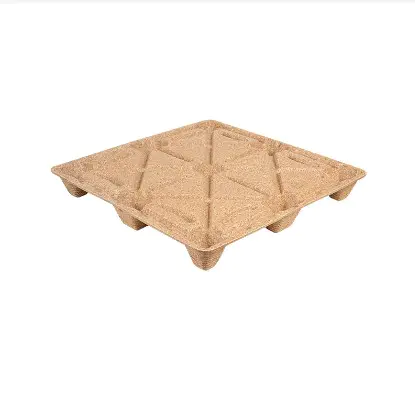
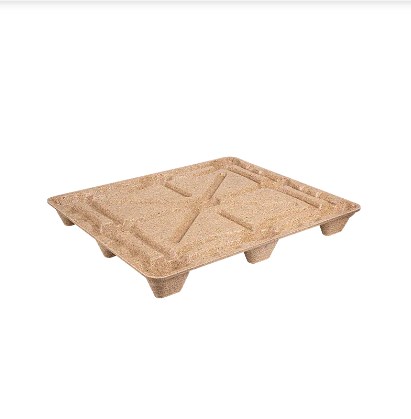
Molded wood pallets differ structurally from traditional nailed pallets.
Instead of assembling separate deckboards, stringers, blocks, and nails, molded pallets can form the deck, feet, ribs, and fork-entry structure as an integrated molded component. Ronsun’s production information describes a process involving prepared wood particles or fibers, binder, mold filling, hot pressing, curing, cooling, and inspection.
That manufacturing method creates several variables buyers should consider when interpreting a test result.
These include:
- pallet thickness;
- reinforcement-rib geometry;
- leg and foot design;
- molded material density;
- material distribution;
- pallet weight;
- moisture control;
- molding consistency;
- load-contact area.
For example, adding material to reinforcement areas can increase strength but may also increase pallet weight and cost.
Likewise, reducing material to create a lightweight pallet may be appropriate for cartons but inappropriate for concentrated industrial loads.
Therefore, test reports should always be tied to the specific pallet model or drawing revision being purchased.
How Buyers Should Read an ISO 8611 Test Report
A statement saying “ISO 8611 tested” is not enough.
The report should allow the buyer to determine exactly what product was tested and under which conditions.
Important items include:
| Item |
What to Verify |
| Test standard |
Exact ISO number and edition |
| Pallet model |
Product code or drawing number |
| Dimensions |
Length × width × height |
| Pallet weight |
Helps confirm sample consistency |
| Material |
Construction and relevant material description |
| Test condition |
Rack, fork, stacking, floor, or other configuration |
| Applied load |
Load actually used during testing |
| Deflection |
Amount of movement during loading |
| Permanent deformation |
Remaining deformation after load removal |
| Damage |
Cracks, fractures, delamination, broken areas, or other failures |
| Samples |
Number and identification of pallets tested |
| Test date |
Confirms report age |
| Photos |
Helps link tested samples with supplied products |
| Laboratory |
Testing organization and accreditation information |
Buyers should pay particular attention to drawing revision and sample identification.
Suppose a supplier tests one molded pallet and later reduces material thickness, changes the reinforcement-rib layout, alters the mold, or changes important material parameters.
The original test report may no longer accurately represent the new pallet.
For long-term supply contracts, buyers can therefore require notification when structural changes are introduced.
How to Verify the Testing Laboratory
For high-value or safety-sensitive applications, buyers may request testing from an accredited third-party laboratory.
ISO/IEC 17025:2017 is the current international standard defining requirements for the competence, impartiality, and consistent operation of testing and calibration laboratories. It was reviewed and confirmed in 2023 and remains current.
When checking laboratory information, buyers should verify:
- laboratory name;
- accreditation body;
- accreditation certificate number;
- validity period;
- testing location;
- applicable scope of accreditation.
The scope is particularly important.
A laboratory may be ISO/IEC 17025 accredited without every test it performs necessarily falling within the accredited scope.
Therefore, buyers should not simply look for an accreditation logo.
They should confirm that the relevant mechanical or pallet-testing activities are covered by the laboratory’s accreditation scope.
ISO 8611 vs ASTM D1185 for U.S. Buyers
U.S. buyers may also encounter ASTM D1185-98a(2025), Standard Test Methods for Pallets and Related Structures Employed in Materials Handling and Shipping.
ASTM lists this standard as active. It includes static compression and bending tests used to estimate pallet stiffness, strength, and safe working loads under specified load and support conditions. It also includes dynamic testing provisions and recommends additional field testing after laboratory acceptance testing.
ISO 8611 and ASTM D1185 should not simply be treated as interchangeable labels.
A purchasing contract should clearly state which method applies.
For example:
Required: ISO 8611-1:2025 and applicable performance requirements according to ISO 8611-2:2025.
This is much clearer than:
Required: Pallet must meet international standards.
If a U.S. customer specifically requires ASTM D1185, that should also be stated before samples are manufactured and sent for testing.
Cost, Lead Time, and Sample Selection
There is no reliable universal price, sample quantity, or lead time for ISO 8611 testing.
The testing program depends on factors such as:
- pallet dimensions;
- pallet construction;
- expected load;
- selected test methods;
- number of specimens;
- conditioning requirements;
- laboratory equipment;
- documentation requirements;
- destructive testing requirements;
- retesting or accelerated service.
Rather than asking a laboratory simply for an “ISO 8611 test price,” buyers should prepare a testing brief.
A useful brief includes:
Pallet drawing: dimensions and structural design.
Pallet material: molded wood, conventional wood, plastic, metal, or composite.
Cargo: total weight and load distribution.
Handling: forklift, pallet jack, conveyor, stacker, or automated equipment.
Storage: floor, stacked, or pallet rack.
Use cycle: one-way export shipment or repeated handling.
Operating environment: warehouse, humid environment, cold storage, or other special conditions.
The laboratory can then recommend an appropriate test matrix and sample quantity.
Put ISO 8611 Requirements Into Your Purchase Contract
Testing is most valuable when it becomes part of the procurement specification.
A professional pallet specification can include:
- exact pallet dimensions;
- approved pallet drawing;
- pallet weight tolerance;
- applicable ISO or ASTM standard;
- nominal load requirement;
- maximum working load where applicable;
- intended rack or support condition;
- cargo distribution;
- permitted deflection or deformation;
- unacceptable damage criteria;
- required laboratory documentation;
- sampling method;
- design-change notification;
- retesting requirements.
For molded wood pallets, buyers may also specify whether changes in structure, mold design, material density, pallet weight, or reinforcement geometry require requalification.
This reduces the risk of approving one pallet design during sampling and receiving a materially different product during mass production.
Food, Pharmaceutical, and Export Applications Need Additional Requirements
ISO 8611 is primarily a mechanical performance standard.
Passing ISO 8611 testing does not automatically mean that a pallet meets every hygiene, pharmaceutical, cold-chain, import, or customer-specific requirement.
These applications may require additional evaluation of factors such as:
- cleanliness;
- moisture exposure;
- contamination risk;
- temperature;
- traceability;
- material restrictions;
- destination-country regulations.
Likewise, export packaging requirements should be evaluated separately from ISO 8611 mechanical testing.
In simple terms:
ISO 8611 answers: Can this pallet achieve the required mechanical performance under defined test conditions?
It does not answer every regulatory or logistics question associated with the goods carried on that pallet.
Choosing the Right Molded Wood Pallet
Before requesting a quotation, buyers should prepare more than a required pallet length and width.
For a more accurate pallet recommendation, provide:
- pallet dimensions;
- cargo weight;
- cargo footprint;
- whether the load is evenly distributed;
- forklift entry direction;
- floor, rack, or stacked storage;
- export destination;
- one-way or reusable operation;
- required standard or test report.
Ronsun Import & Export Co., Ltd. specializes in molded and pressed wood pallet solutions for logistics, warehousing, manufacturing, and international shipping. Its product range includes multiple pallet footprints and structural configurations, with standard and customized solutions available for different handling requirements.
For custom applications, pallet dimensions and structural design should be evaluated together with the actual cargo and handling environment rather than simply selecting the highest published load rating.
FAQ
What do ISO 8611 Parts 1, 2, 3, and 4 cover?
ISO 8611-1 defines test methods. ISO 8611-2 defines performance requirements and test selection. ISO 8611-3 addresses maximum working loads for known payloads and handling environments. ISO/TS 8611-4 is a specialized procedure for predicting creep behavior in certain plastic-pallet stiffness tests.
Is ISO 8611 the same as a static-load test?
No. ISO 8611 covers a broader evaluation framework involving nominal load, maximum working load, different handling environments, stiffness, and durability-related testing.
What pallet test should I request for warehouse racking?
The selected test should represent the actual support condition, payload, and handling environment. Tell the supplier and laboratory how the pallet will sit on the rack and how the cargo is distributed rather than requesting only a generic load test.
How can I verify a pallet test report?
Check the standard edition, pallet model, dimensions, structural design, test configuration, applied load, deflection, damage, sample identification, photographs, testing laboratory, and report date.
Does ISO/IEC 17025 accreditation mean every test from a laboratory is accredited?
Not necessarily. Buyers should verify the laboratory’s current accreditation and confirm that the relevant testing activity is included within its applicable scope.
Should a pallet be retested after a design change?
Potentially, yes. Changes to important structural characteristics, material distribution, thickness, reinforcement geometry, molding parameters, or other load-bearing features can affect pallet performance. Significant changes should be reviewed to determine whether requalification is necessary.
Conclusion
ISO 8611 helps buyers move beyond vague pallet descriptions such as “heavy duty” or “2,000 kg capacity.”
A meaningful pallet rating must be connected to a defined pallet design, load condition, support configuration, test method, and operating environment.
For molded wood pallet procurement, buyers should therefore evaluate the test report together with the pallet drawing, structural design, intended cargo, and actual material-handling process.
That approach makes supplier comparison more transparent and helps reduce the risk of pallet deformation, load instability, premature failure, and specification disputes.
If you are evaluating a standard or customized molded wood pallet, provide Ronsun Import & Export Co., Ltd. with your pallet size, cargo weight, load distribution, storage method, and handling conditions. These details provide a much stronger basis for selecting a suitable pallet than a load-capacity number alone.
 English
 Français
 Español
 عربى
عربى