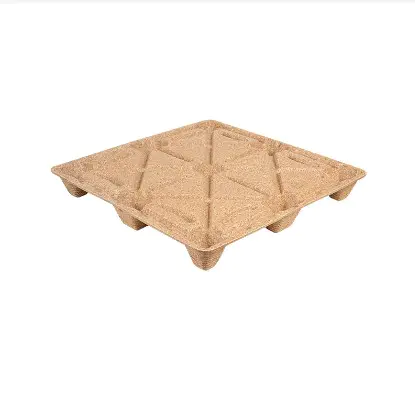
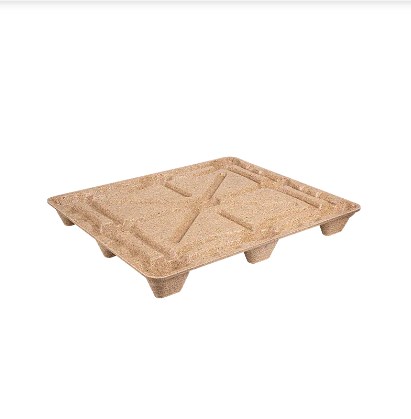
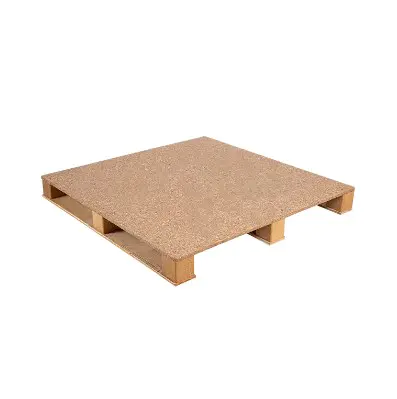
As manufacturers, exporters and logistics companies place greater emphasis on material efficiency and waste reduction, recycled wood fiber is moving from a low-value by-product to an engineered raw material for industrial packaging. Wood shavings, sawdust, clean production offcuts and other suitable recovered fibers can increasingly be converted into molded packaging components, protective structures and pressed wood pallets rather than being discarded or used only as low-grade fuel.
The shift is not simply an environmental trend. Industrial buyers are examining recycled fiber through a much broader set of criteria: carbon footprint, structural performance, production consistency, storage efficiency, export compliance and total cost of ownership. For manufacturers, this means that the value of recycled wood fiber increasingly depends on how well the material is collected, processed, engineered and integrated into a controlled manufacturing system.
Key trend: Recycled wood fiber is becoming more relevant where manufacturers can convert variable waste streams into dimensionally consistent, testable and commercially repeatable packaging products.
Environmental Impact and Lifecycle Carbon Footprint
Environmental comparisons should begin with a defined life-cycle assessment boundary rather than a general claim that recycled material is automatically “greener.” ISO 14040 and ISO 14044 provide the internationally recognized framework for life-cycle assessment, including goal and scope definition, inventory analysis, impact assessment and interpretation. A cradle-to-gate study stops when the packaging leaves the factory, while a cradle-to-grave assessment also considers transportation, use, recovery and final disposal.
For recycled wood fiber packaging, the most important variables usually include collection distance, contamination removal, particle-size reduction, drying energy, binder consumption, molding energy, outbound transport and end-of-life treatment. Biogenic carbon also needs transparent accounting. Carbon stored temporarily in wood should not simply be treated as a permanent emissions credit without explaining the accounting method and eventual disposal pathway.
| LCA Variable |
Lower-Impact Scenario |
Higher-Impact Scenario |
| Feedstock |
Clean local production residues |
Mixed recovered wood requiring intensive sorting |
| Moisture |
Relatively dry residues |
Wet material requiring substantial thermal drying |
| Electricity |
Lower-carbon electricity supply |
Carbon-intensive electricity mix |
| Transport |
Regional sourcing |
Long-distance feedstock movement |
| End of life |
Reuse, material recovery or controlled recycling |
Landfill without material recovery |
Regional electricity is particularly important for energy-intensive drying and hot pressing. In the United States, for example, EPA eGRID data show substantial differences in power-sector CO₂-equivalent emission rates between electricity subregions, meaning that identical manufacturing equipment can produce different cradle-to-gate results depending on location.
For international buyers, the more useful question is therefore not “How much lower is the carbon footprint?” but rather: What feedstock, energy mix, transport distance and end-of-life assumptions were used to calculate it?
Mechanical Performance and Design for Industrial Packaging
Using recycled fiber does not remove the need for conventional engineering discipline. Industrial transport packaging must withstand compression, bending, vibration, impact, humidity and repeated handling. For pallets in particular, performance should be evaluated at the level of the finished design rather than inferred solely from the raw fiber.
ISO 8611-1:2025 specifies test methods for new flat pallets, including nominal load testing, maximum working load testing and durability comparison. ASTM D1185 also addresses pallet performance through static compression, bending and dynamic testing under defined support and load conditions. Both approaches reinforce an important point: laboratory testing should reflect the actual pallet design and intended distribution environment rather than rely on a universal strength threshold.
Material Variables
- Fiber species and particle distribution
- Moisture content before molding
- Binder type and dosage
- Foreign-material contamination
- Bulk and molded density
Process Variables
- Charge weight consistency
- Mold temperature
- Pressing pressure
- Curing time
- Cooling and conditioning
Design for manufacturability is equally important. Excessively thin areas can become local stress concentrations, while uneven fiber distribution can create weak zones. High moisture can interfere with curing or dimensional stability, and excessive fines may increase binder demand. Mold geometry must also account for fork-entry areas, feet, ribs and other high-load features.
Incoming material inspection therefore needs to detect metal fragments, plastics, stones, painted or treated wood, oversized particles and unacceptable moisture before the fiber reaches the forming process. In molded pallet production, controlling this variability is what turns recycled feedstock into an engineered product rather than simply compressed waste material.
Cost, Total Cost of Ownership and Material Alternatives
Purchase price alone gives an incomplete picture of industrial packaging economics. Recycled wood fiber may reduce dependence on virgin timber or other primary materials, but production still requires sorting, size reduction, drying, resin, energy, tooling and quality control. The financial case therefore depends heavily on the finished product and logistics system.
| Material / Format |
Typical Strength |
Storage Efficiency |
Common Use |
| Traditional timber pallet |
High, design-dependent |
Generally limited nesting |
General industrial logistics |
| Molded recycled-fiber pallet |
Engineered by mold and density |
Can be highly nestable |
Export, warehousing and one-way logistics |
| Corrugated / fiber pallet |
Lower to moderate |
Lightweight |
Selected light-duty shipments |
| Plastic pallet |
Moderate to high |
Design-dependent |
Closed-loop and hygienic systems |
A practical total-cost-of-ownership model should include the packaging purchase price, inbound freight, warehouse space, outbound transportation, treatment requirements, product damage, handling losses and disposal or recovery costs. For nestable molded pallets, storage and return-volume reduction can sometimes matter as much as the initial unit price.
Practical TCO Model
Purchase Cost + Inbound Freight + Storage + Outbound Logistics + Handling Losses + Compliance/Treatment + End-of-Life Cost − Recovery Value
There is therefore no universal ROI period for switching to recycled wood fiber packaging. A manufacturer shipping 100,000 pallets internationally faces a very different calculation from a regional warehouse operating a closed pallet pool. Procurement teams should model their own annual volume, shipping distance, pallet utilization, nesting ratio, damage rate and disposal system before making a material decision.
Feedstock Sourcing, Quality Control and Manufacturing Integration
The recycled fiber supply chain begins well before the molding press. Potential feedstocks include sawdust, planer shavings, clean lumber offcuts, furniture-manufacturing residues and other suitable wood-processing by-products. In some applications, agricultural fibers can also supplement wood-based material, although formulation and performance need separate validation.
Availability varies significantly by region. Areas with concentrated sawmilling, furniture production, panel manufacturing or other wood-processing industries typically have more accessible residue streams. However, proximity alone does not guarantee quality. Manufacturers need specifications covering origin, contamination, moisture, particle size and consistency between deliveries.
Collection → Sorting → Crushing → Screening → Drying → Binder Mixing → Hot Molding → Inspection
A useful receiving program should begin with supplier identification and visual inspection, followed by moisture measurement, contamination checks and periodic particle-distribution testing. Metallic contamination is particularly important because it can damage processing equipment and molds. Treated or chemically contaminated wood may also create regulatory, worker-safety or end-of-life issues and should not be mixed indiscriminately with clean feedstock.
During production, trial batches are normally more valuable than immediately scaling to full output. Manufacturers can establish a baseline recipe, measure dimensional consistency and mechanical performance, adjust moisture and binder levels, and then validate the finished packaging under representative load conditions. Ronsun's molded pallet manufacturing process similarly relies on steps including crushing and screening, moisture conditioning, adhesive mixing, molding, curing and final inspection.
Compliance, Sustainability Claims and End-of-Life Options
As recycled content becomes a commercial selling point, environmental claims require greater precision. In the United States, the FTC Green Guides distinguish between claims such as recycled content, recyclable and compostable. Partial recycled-content claims should identify the relevant proportion, while recyclability claims may need qualification when appropriate recycling infrastructure is not widely available.
Certification should also be matched to the actual product. FSC, for example, uses separate FSC 100%, FSC Mix and FSC Recycled labels; FSC Recycled identifies products made from recycled fiber under the certification system.
“Compostable” should not be treated as a synonym for bio-based or wood-based. BPI's commercial compostability program evaluates eligible products against defined ASTM requirements, with separate conditions applying to commercial and home compostability. A fiber product therefore should not be marketed as certified compostable unless the complete finished product and its additives meet the applicable requirements.
For international transport packaging, another important distinction concerns ISPM 15. The standard regulates wood packaging such as conventional pallets that may present a phytosanitary pathway, but it exempts packaging made wholly from processed wood materials created using glue, heat, pressure or a combination of these processes. Actual product construction and destination-country requirements should still be verified for each shipment.
End-of-life planning should likewise be determined locally. Depending on product composition and regional infrastructure, pathways may include reuse, fiber recovery, controlled recycling, energy recovery or landfill. The most credible sustainability strategy is therefore one that links material choice to the recycling and waste-management systems that actually exist in the destination market.
Recycled Fiber Is Becoming an Engineered Packaging Resource
The growing role of recycled wood fiber reflects a broader change in industrial packaging. Waste reduction alone is no longer enough. Buyers increasingly expect recycled materials to deliver repeatable mechanical performance, measurable environmental benefits, traceable sourcing and compatibility with real logistics systems.
For molded wood pallets, recycled fiber is particularly relevant because high-temperature, high-pressure molding can convert prepared wood residues into an integrated pallet structure with controlled geometry. Ronsun Import & Export Co., Ltd. supplies molded wood pallet solutions manufactured from recycled plant fibers for logistics, warehousing and international shipping applications.
Evaluating Molded Wood Pallets for Your Supply Chain?
Ronsun can support manufacturers, exporters and logistics companies evaluating standard or customized molded wood pallets according to pallet dimensions, cargo weight, handling requirements, storage conditions and export destinations.
Contact Ronsun for Pallet Specifications
Frequently Asked Questions
How does the lifecycle carbon footprint of recycled wood fiber packaging compare with virgin fiber, corrugated packaging and plastics?
There is no single defensible percentage that applies to every product. Results depend on feedstock source, drying energy, binder use, electricity mix, transport distance, product weight, reuse and end-of-life treatment. A comparable LCA should use the same functional unit and clearly defined system boundaries.
What mechanical tests should manufacturers use for recycled wood fiber pallets?
Finished pallet designs can be evaluated using standards such as ISO 8611-1 and ASTM D1185. Testing should reflect the expected load, support method, handling equipment and distribution environment rather than relying on one universal strength requirement.
What determines the ROI when switching to recycled wood fiber industrial packaging?
ROI depends on more than unit price. Buyers should include freight, warehouse space, nesting efficiency, treatment requirements, handling losses, product damage and end-of-life costs when comparing alternatives.
What should procurement teams require from recycled wood fiber suppliers?
Specifications should address feedstock origin, moisture, particle distribution, prohibited contaminants, batch consistency and traceability. Periodic incoming inspection is especially important when material comes from multiple recovery streams.
What are the main challenges when integrating recycled fiber into production?
Common challenges include changing moisture levels, inconsistent particle size, contamination, seasonal feedstock variation, binder adjustment and maintaining stable molded density. Pilot production and defined quality-control checkpoints can reduce these risks.
Can recycled wood fiber packaging automatically be called recyclable, biodegradable or compostable?
No. These terms describe different attributes and may be subject to different regulatory or certification requirements. Environmental claims should reflect the finished product, its additives and the waste-management infrastructure available where the product is sold or used.
 English
 Français
 Español
 عربى
عربى