For decades, the conventional nailed wood pallet has been the default platform for warehousing and freight. It is widely available, familiar to forklift operators, relatively easy to repair, and supported by an established recycling network.
However, molded wood pallets are increasingly considered for export shipments, closed-loop logistics, manufacturing plants, distribution centers, and operations where storage density and pallet consistency matter.
The right question is therefore not simply, “Which pallet is stronger or cheaper?” A procurement team should compare dimensions, weight, load conditions, rack support, return logistics, hygiene requirements, export regulations, automation compatibility, and total cost per trip.
Here is how molded pallets and traditional wood pallets compare.
Material Composition, Standard Sizes, and Unit Weight
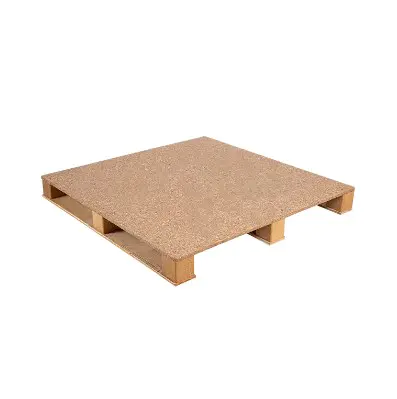
Traditional wood pallets are normally assembled from sawn lumber using deck boards, stringers or blocks, and nails or other fasteners. Depending on the pallet design, hardwood, softwood, engineered wood components, or combinations of these materials may be used.
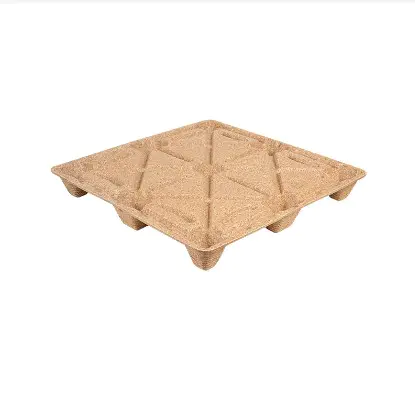
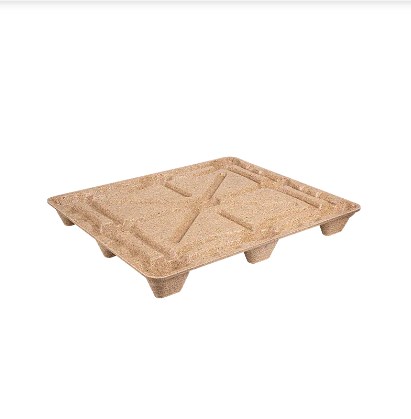
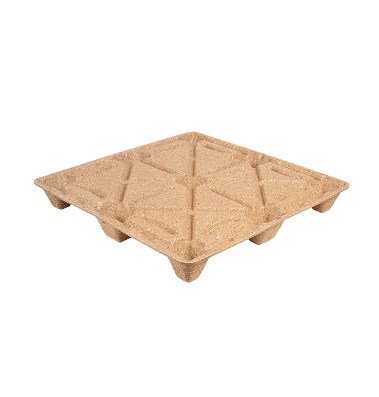
Molded wood pallets take a different manufacturing approach. Wood fibers, wood chips, sawdust, or other processed wood materials are combined with a binder and formed under heat and pressure. Instead of assembling individual boards and blocks, the process creates an integrated pallet body.
This difference affects dimensional consistency, projections, fasteners, weight distribution, and nestability.
For U.S. distribution, 48 × 40 inches remains one of the most important pallet footprints, particularly in grocery, consumer goods, food, retail, and general logistics. International supply chains also commonly use metric footprints such as 1200 × 1000 mm and 1200 × 800 mm.
Weight should not be evaluated by material name alone.
A conventional 48 × 40-inch wood pallet may commonly fall somewhere around the 35-50+ lb range depending on lumber thickness, moisture level, species, and construction. Molded pallets can also vary substantially.
For example, Ronsun’s current molded wood pallet range includes designs around 16 kg, 21 kg, 23.5 kg, and 26 kg depending on size and structural configuration. Therefore, buyers should not assume that every molded pallet is automatically lighter than every traditional pallet.
A useful specification request should include:
| Parameter |
What the Buyer Should Confirm |
| Length × width |
Compatibility with product and handling system |
| Overall height |
Forklift, conveyor and warehouse clearance |
| Unit weight |
Freight and manual-handling impact |
| Fork entry |
Two-way or four-way |
| Nesting ratio |
Empty pallet storage and return efficiency |
| Moisture sensitivity |
Indoor, outdoor and wet-use conditions |
| Dimensional tolerance |
Automation and conveyor compatibility |
The key is to compare specific pallet designs, rather than comparing “molded wood” and “traditional wood” only as material categories.
Load Capacity, Rackability, and Impact Resistance
Load ratings are among the most misunderstood pallet specifications.
A pallet can have very different capacities depending on how it is supported. Buyers normally need to distinguish between static load, dynamic load, and rack load.
Static load describes a pallet resting on a substantially flat surface. Dynamic load applies while the loaded pallet is being moved. Rack loading can be more demanding because the pallet may be supported only along selected edges or beams.
This means a statement such as “3,000 lb capacity” is incomplete unless the supplier also explains the support condition and load distribution used to obtain that figure.
ISO 8611 provides standardized methods for evaluating new flat pallets, including nominal load, maximum working load, and durability-related testing. It is therefore more useful to request documented test conditions than to compare the largest number printed in two product brochures.
Traditional nailed wood pallets have an important advantage in established heavy-duty systems: many designs have decades of field experience, and damaged deck boards or stringers can often be replaced.
Their weakness is variation. Lumber moisture, knots, board thickness, nail position, previous repairs, and repeated impacts can influence performance from pallet to pallet.
Molded pallets provide more repeatable geometry because their structure is formed in a controlled mold. Their one-piece construction also eliminates loose nails and reduces some protruding-component problems.
But buyers need to be particularly careful with unsupported pallet racking.
A pallet that performs well on a warehouse floor or roller conveyor does not automatically have the same capacity when spanning two rack beams. Heavy concentrated loads can produce bending or localized deformation.
For rack storage, ask the manufacturer for:
- maximum working load under the exact rack configuration;
- beam spacing used during testing;
- uniformly distributed versus concentrated load conditions;
- allowable deflection;
- temperature and humidity conditions;
- expected cycle life.
For very heavy industrial products or severe repeated forklift impact, a conventional repairable wood pallet may still be the more practical choice.
Total Cost of Ownership: Freight, Nesting, and End-of-Life Economics
Comparing pallet purchase prices alone can produce the wrong sourcing decision.
A more useful calculation is:
Total Pallet Cost per Trip = Purchase Cost + Freight + Storage + Handling + Repair + Compliance + Disposal − Recovery Value
Then divide the result by the expected number of usable trips.
Consider a simplified example.
Suppose Pallet A costs $15 and survives three usable trips. Pallet B costs $22 but survives six trips.
Ignoring all other factors:
- Pallet A: $15 ÷ 3 = $5.00 per trip
- Pallet B: $22 ÷ 6 = $3.67 per trip
The higher-priced pallet is actually less expensive per use.
Return logistics can change the calculation even further.
Many molded pallet designs can be nested, meaning empty pallets fit partially inside each other. Ten nested pallets may therefore occupy much less vertical space than ten conventional non-nestable wood pallets.
That can reduce:
- empty-pallet warehouse space;
- return truck volume;
- container utilization for pallet repositioning;
- handling movements;
- storage locations required for pallet inventory.
The largest benefit normally appears in supply chains that actually return or reposition empty pallets. In a one-way export shipment where the receiver disposes of the pallet immediately, nestability may offer little financial return to the original shipper.
Traditional wood pallets also retain an important economic advantage: they have a mature repair ecosystem. Individual boards can often be replaced instead of discarding the complete pallet.
A severely damaged one-piece molded pallet usually cannot be repaired by simply nailing on a replacement deck board. Recycling or material recovery may therefore be a better end-of-life route than conventional pallet repair.
Ronsun describes its molded pallet portfolio as recyclable and offers pallet designs intended for reuse, storage, and international transport. Buyers evaluating sustainability claims should nevertheless confirm the actual recycling route available in the destination market rather than assuming theoretical recyclability equals local recycling availability.
For procurement teams, the useful question becomes:
How much does the pallet cost for every successful product movement—not how much does it cost at the factory gate?
Hygiene, Chemical Resistance, Fire Safety, and Export Compliance
Export compliance is one of the areas where molded wood pallets can offer a meaningful operational advantage.
ISPM 15 regulates wood packaging material that can carry wood pests in international trade. For wood packaging entering the United States, regulated solid wood packaging generally needs appropriate treatment and marking. USDA APHIS currently states that regulated WPM entering the U.S. must comply with ISPM 15 requirements.
However, ISPM 15 excludes certain packaging made wholly from processed wood materials—examples include plywood, particleboard, oriented strand board, and similar wood products manufactured in a way that sufficiently eliminates pest risk.
This is the regulatory basis behind the common “fumigation-free” advantage associated with qualifying molded or processed-wood pallets.
The wording matters.
A purchaser should confirm that the specific pallet construction qualifies for the relevant exemption and is accepted by the destination country, rather than relying only on a generic “ISPM-15 pallet” marketing label.
Hygiene also requires careful interpretation.
Molded pallets have no exposed nails and can offer smoother, more consistent surfaces with fewer gaps than many conventional wood pallets. Those characteristics may make inspection and housekeeping easier.
But that does not automatically make a pallet “FDA approved.”
FDA guidance for sanitary food transportation emphasizes preventing contamination and maintaining suitable sanitary conditions, including using pallets of appropriate quality and condition. Pallet suitability therefore depends on the complete food handling system, particularly whether packaged food or exposed food could contact the pallet.
Chemical resistance should likewise be verified against the actual substance involved. Acids, alkalis, oils, solvents, cleaning chemicals, and water can affect wood fibers and binders differently.
Fire performance is also product-specific rather than category-wide. Neither “wood pallet” nor “molded pallet” should be assigned a universal fire rating. Warehouses with sprinkler, insurance, or fire-code requirements should request applicable test reports and confirm requirements with their local authority, insurer, or fire-protection engineer.
Industry Applications, Automation Compatibility, and Final Buying Considerations
There is no universal winner.
The better pallet is determined by the operating environment.
| Application |
Often Worth Considering |
| One-way international export |
Molded pallet |
| Closed-loop distribution |
Molded or durable traditional pallet |
| Automated conveyor system |
Dimensionally consistent molded pallet |
| Food/beverage packaged goods |
Smooth, cleanable pallet designs |
| Automotive components |
Depends strongly on load and rack conditions |
| Heavy industrial rack storage |
Tested heavy-duty wood or engineered pallet |
| Low-cost local shipping |
Traditional wood pallet |
| Operations requiring frequent field repair |
Traditional wood pallet |
| Empty-pallet return logistics |
Nestable molded pallet |
| Custom export packaging |
Molded pallet can be attractive |
Automation deserves special attention.
Conveyors, AS/RS systems, pallet dispensers, AGVs, robotic handling equipment, and automated forklifts generally benefit from predictable dimensions and fork-entry geometry. Variation caused by broken boards, protruding nails, or previous repairs can be problematic.
Molded manufacturing can reduce some of those dimensional inconsistencies.
That does not mean every molded pallet is automation-ready. Buyers should provide the supplier with conveyor type, roller spacing, rack configuration, AGV fork geometry, load center, unit-load dimensions, and maximum payload before approving a pallet.
Traditional pallets still make sense when availability, low initial cost, extremely heavy loads, repairability, or a strong local pallet pooling and recycling network matters more than nesting or export convenience.
The most reliable purchasing process is therefore to test a representative sample under actual warehouse conditions before converting an entire pallet fleet.
Molded or Traditional: How Should You Choose?
For simple domestic shipments where pallets are inexpensive, locally available, routinely repaired, and unlikely to return, a conventional wood pallet remains difficult to beat.
For international shipping, high-volume standardized logistics, automated handling, or operations where empty-pallet storage and return freight matter, molded pallets deserve a closer TCO analysis.
Ronsun Import & Export Co., Ltd. specializes in molded wood pallet solutions for storage, transportation, and international supply chains, including standard and customized configurations.
Instead of selecting a pallet from dimensions alone, buyers can provide cargo weight, unit-load dimensions, rack conditions, forklift entry direction, shipment destination, annual quantity, and return-loop requirements.
Ronsun can then help evaluate an appropriate molded pallet configuration and prepare samples or quotations for operational testing before larger-volume purchasing.
FAQ
What is the actual difference between a molded pallet and a traditional wood pallet?
A traditional pallet is normally assembled from sawn boards, blocks or stringers and fasteners. A molded wood pallet is formed from processed wood fibers or particles with a binder under heat and pressure, creating an integrated structure.
Which pallet option is more cost-effective over five or more years?
It depends on trips per pallet, damage rates, repair costs, return freight, storage space and disposal value. Compare cost per successful trip, not purchase price alone. A more expensive pallet can have a lower lifetime cost if it delivers more usable cycles or significantly lowers return-logistics costs.
What load capacity and racking performance can I expect from a molded pallet?
There is no universal rating. Capacity depends on pallet geometry, material formulation, load distribution and support conditions. Request static, dynamic and rack-load data separately and preferably test information based on recognized procedures such as ISO 8611.
Are molded pallets food-safe and export-compliant?
Qualifying processed-wood packaging may fall outside ISPM 15 treatment requirements, but this should be confirmed for the specific product and destination. For food applications, do not rely solely on an “FDA approved” claim; assess pallet condition, materials, sanitation procedures and actual food-contact conditions.
What are the standard dimensions and typical weights?
The 48 × 40-inch footprint is widely used in U.S. distribution, while 1200 × 1000 mm and 1200 × 800 mm are common international formats. Weight varies substantially by construction, so obtain the exact unit weight for the pallet being quoted rather than relying on a generic material comparison.
Can molded pallets be recycled, repaired, or returned after use?
They can potentially be reused, returned and recycled depending on construction and local recycling infrastructure. Unlike conventional nailed pallets, however, major structural damage usually cannot be repaired simply by replacing one board.
When do traditional wood pallets still make more sense?
Traditional pallets remain attractive for inexpensive domestic movements, severe impact environments, applications requiring easy field repair, very heavy-duty configurations, and locations with strong local pallet repair and recycling networks.
 English
 Français
 Español
 عربى
عربى