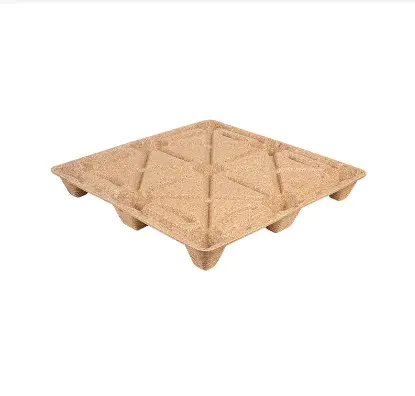
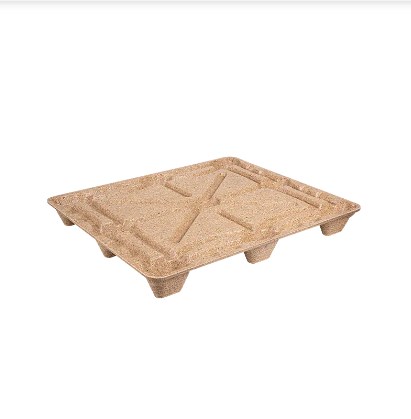
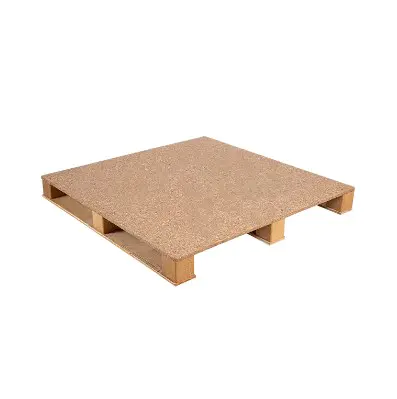
Warehouse automation is changing what companies expect from a pallet. In a conventional warehouse, an experienced forklift operator can compensate for a slightly warped pallet, an uneven fork opening or a minor dimensional difference. Automated conveyors, AGVs, pallet shuttles and AS/RS equipment do not have the same flexibility. They depend on predictable dimensions, repeatable support points and clearly defined operating tolerances.
As more warehouses introduce automated material handling, pallet consistency is becoming more than a manufacturing-quality issue. Variations in length, width, height, flatness, foot position or deflection can affect sensors, conveyors, robotic handling and storage equipment. A pallet may still carry its cargo successfully while creating problems for the automation around it.
Key shift: In an automated warehouse, pallet performance is not only about carrying the load. The pallet must also repeatedly interact with machines in the same predictable way.
Automation Changes What a Warehouse Requires From a Pallet
Manual material handling contains a built-in correction system: the operator. A forklift driver can approach a pallet at a slightly different angle, raise or lower the forks, compensate for a small positional error and avoid a damaged corner.
Automated systems normally work differently. A conveyor expects the load to arrive within a defined position. An AGV follows programmed approach coordinates. A shuttle expects pallet supports to be where the system was designed to find them. Sensors monitor specific zones rather than visually interpreting the entire pallet.
| Conventional Handling |
Automated Handling |
| Operator can adjust pallet position |
Positioning follows programmed logic |
| Minor variation may be visually corrected |
Variation may trigger a sensor or handling error |
| Fork angle and height can be adjusted manually |
Fork-entry geometry must remain predictable |
| Damaged pallets can be handled selectively |
Exceptions may interrupt the automated flow |
This does not mean an automated warehouse requires perfectly identical pallets. Every system has tolerances. The important difference is that those tolerances should be understood, specified and maintained instead of being left to operator judgment.
Which Pallet Dimensions Matter Most in Automated Handling?
Pallet specifications are often reduced to a simple length-by-width number. For automation, that is not enough. Multiple dimensions can determine whether the pallet interfaces correctly with the equipment.
Overall Length and Width
These dimensions affect conveyor guides, pallet stops, accumulation positions and transfer points. If actual production dimensions move outside the expected range, a pallet may contact guides differently or fail to align with the next machine.
Overall Height
Pallet height can affect lift tables, transfer mechanisms, automated fork positioning and vertical clearances. Variation may also change where a sensor detects the pallet or load.
Fork-Entry Dimensions
Automated forklifts and AGVs require predictable openings. Entry height, width and the position of pallet feet should remain compatible with the fork geometry and approach path.
Foot and Support Position
For molded pallets, the location of feet and other bottom structures is particularly important. These areas may need to align with conveyor rollers, chain tracks, rack beams or shuttle supports.
Flatness and Squareness
A pallet can meet its nominal length and width while still being twisted or out of square. That may be tolerable in some manual operations but can create alignment problems when clearances are smaller.
| Pallet Characteristic |
Possible Automation Impact |
| Length and width |
Guides, pallet stops and positioning |
| Overall height |
Transfer and sensor clearance |
| Fork-entry dimensions |
AGV and automated forklift access |
| Foot position |
Conveyor and rack support |
| Flatness |
Stable travel and load positioning |
| Squareness |
Alignment through narrow guides and transfers |
Conveyor Systems Are Sensitive to Pallet Bottom Geometry
A pallet that works well with a conventional forklift is not automatically suitable for every conveyor system. The bottom structure must match the way the conveyor supports and moves the unit load.
Roller Conveyors
Load-bearing areas need sufficient contact with the rollers. Poor support spacing can cause unstable movement or local pallet deflection.
Chain Conveyors
The pallet bottom must align with defined chain tracks so that the load is supported consistently during movement.
Transfer Stations
Direction changes can expose problems with pallet squareness, uneven feet or irregular bottom geometry.
Accumulation Zones
Consistent outer dimensions help maintain predictable spacing between sequential unit loads.
Roller spacing deserves particular attention. If pallet feet or support zones fall between rollers rather than across them, local loads can increase and pallet stability can change. Chain conveyors create a different requirement because the load is concentrated along defined support lines.
This is why buyers planning an automated system should provide the pallet supplier with actual conveyor information rather than simply requesting a standard pallet size.
AS/RS Makes Pallet Deflection as Important as Pallet Dimensions
Automated Storage and Retrieval Systems introduce another variable: pallet deflection under load.
A pallet may meet its dimensional specification when empty but bend after a heavy payload is placed on the deck. Whether that matters depends on the support arrangement. A pallet resting fully on a floor behaves differently from one supported only along rack beams, rails or selected shuttle contact points.
A pallet does not need to break to cause an automation problem. Excessive deflection alone can interfere with equipment clearance, positioning or support.
In an AS/RS application, excessive deflection can potentially affect:
- shuttle clearance beneath the pallet,
- contact between the pallet and storage structure,
- sensor positions,
- load stability,
- retrieval accuracy, and
- repeatable placement in storage locations.
For this reason, asking only for a “static load capacity” does not provide enough information for many automated storage applications. Buyers should also consider pallet stiffness and expected deflection under the actual support configuration.
Load testing should reproduce relevant handling conditions as closely as practical. The finished pallet design, support points, payload distribution and expected environment all influence the result.
AGVs and Automated Forklifts Need Predictable Fork Entry
Automated guided vehicles and autonomous forklifts reduce the amount of real-time human correction available during pallet pickup.
The machine normally approaches an expected pallet position using programmed coordinates, sensors or vision guidance. If the pallet is warped, shifted or has inconsistent fork openings, the forks may not enter as expected.
Detect Pallet → Align Vehicle → Enter Fork Opening → Lift Load → Transport
Problems can arise if the fork-entry height becomes too small, pallet feet are displaced, or dimensional variation moves the opening away from the expected location. The result may be a retry, an equipment alarm, manual intervention or physical contact with the pallet.
Four-way entry can provide useful route flexibility, but it does not automatically make a pallet compatible with every AGV. Fork spacing, fork thickness, approach direction, minimum clearance and pallet support geometry still need to match the specific handling equipment.
Dimensional Variation Can Create Downtime, Not Just Pallet Damage
In a manual warehouse, one problematic pallet may slow a forklift operator for several seconds. In a highly automated facility, one pallet can interrupt an entire material-flow sequence.
Pallet Variation → Positioning Error → Equipment Exception → Manual Intervention → Lost Throughput
The commercial cost of inconsistency can therefore extend beyond replacement of the pallet itself. It can include:
- conveyor jams,
- AGV handling errors,
- manual pallet removal,
- production interruptions,
- cargo rehandling,
- maintenance intervention, and
- reduced warehouse throughput.
Actual downtime cost varies widely between facilities, so there is no meaningful universal value per pallet failure. A high-throughput manufacturing line and a lower-volume distribution warehouse can experience very different consequences from the same handling exception.
Why Molded Pallets Can Support Dimensional Repeatability
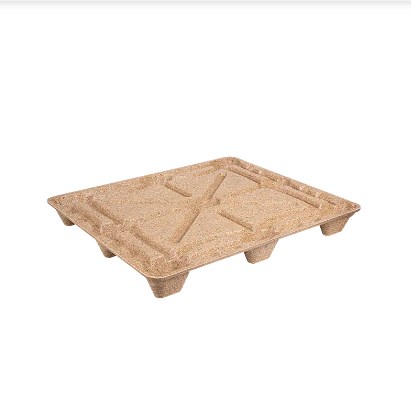
Molded pallet manufacturing offers an important advantage for applications where repeatable geometry matters. Major features—including the deck, ribs, feet and fork-entry areas—are formed by a defined mold rather than assembled individually from multiple boards and blocks.
This provides a geometric foundation for consistent production. However, molding alone does not guarantee consistency.
Actual pallet dimensions can still be affected by:
- wood-fiber moisture,
- particle distribution,
- charge weight,
- binder consistency,
- press temperature,
- mold condition,
- demolding, and
- cooling conditions.
Repeatable Geometry Stable Mold + Controlled Raw Material + Consistent Pressing + Controlled Cooling
Tool wear also needs attention. If a production mold gradually changes or becomes damaged, pallet dimensions can drift even though the original design has not changed.
For this reason, dimensional consistency should be treated as a process-control result rather than simply a feature of the manufacturing method.
Pallet Flatness and Warpage Become More Important in Automation
Warpage illustrates why nominal length and width do not tell the whole story.
A pallet can technically remain within its overall footprint specification while one foot sits higher than another, the deck curves upward or the entire pallet twists diagonally. These conditions can change how the pallet contacts automated equipment.
| Pallet Condition |
Possible Automated-System Risk |
| Warped foot |
Unstable conveyor contact |
| Curved deck |
Changing load position or clearance |
| Uneven overall height |
Inconsistent sensor detection |
| Twisted pallet |
Misalignment at conveyor guides or transfers |
| Uneven support points |
Changing load distribution |
For molded wood pallets, warpage can be influenced by moisture variation, uneven material density, differences in curing and post-press cooling. These manufacturing variables become downstream automation variables once the pallet enters the warehouse.
Sensors and Vision Systems Also Depend on Predictable Pallet Positioning
Modern warehouses do not interact with pallets only through mechanical contact. Sensors, barcode readers, RFID systems and cameras may be used to identify, position and track unit loads throughout the facility.
Photoelectric sensors may confirm that a pallet has entered a position. Barcode readers may expect a label within a defined field of view. Vision systems may identify load edges or determine whether a pallet is correctly aligned before the next movement.
Consistent pallet geometry can help keep the unit load in a predictable position relative to these systems. It can also support standardized label placement when the packaging and cargo configuration remain consistent.
However, pallet geometry is only one part of sensor reliability. Label condition, cargo shape, lighting, sensor selection, contamination and system configuration can all influence detection performance.
What Buyers Should Specify for Pallets Used in Automated Warehouses
A purchasing specification for an automated warehouse should contain more information than nominal pallet size and headline load capacity.
The pallet supplier needs to understand how the product will actually move through the system.
01
Pallet Dimensions
Length, width, overall height and permitted dimensional tolerances.
02
Bottom Geometry
Foot positions, support zones and areas contacting conveyors or racks.
03
Fork Entry
Opening height, width, direction and relevant AGV or forklift dimensions.
04
Payload
Total cargo weight, footprint, load distribution and center-of-gravity considerations.
05
Automation Equipment
Conveyor type, roller spacing, chain position, AGV design and transfer equipment.
06
Storage Support
Rack beams, rails, shuttle supports or other contact arrangements.
07
Environment
Warehouse temperature, humidity and other conditions affecting pallet stability.
08
Performance Limits
Acceptable deflection, dimensional variation and repeated handling requirements.
| Automation Requirement |
Information Buyers Should Provide |
| Roller conveyor |
Roller diameter, spacing and direction of travel |
| Chain conveyor |
Chain-track positions and support direction |
| AS/RS |
Storage support geometry and clearance |
| AGV / automated forklift |
Fork size, spacing and entry direction |
| Racking |
Beam or support spacing |
| Payload |
Weight, footprint and distribution |
| Operating environment |
Temperature, humidity and handling frequency |
Providing this information before pallet selection is much more reliable than choosing a pallet first and testing automation compatibility later.
In Automated Warehouses, Consistency Becomes a Performance Requirement
Automation changes the definition of pallet quality. Carrying the cargo remains essential, but it is no longer the only question.
Warehouse operators increasingly need to know whether every pallet will enter the conveyor in the same way, whether its feet align with the support structure, whether an AGV can enter reliably, whether the deck remains sufficiently flat and whether deflection stays within the operating clearance of the automated equipment.
This makes pallet consistency a system-level requirement rather than simply a manufacturing preference.
Molded wood pallets can provide repeatable geometry because important structural features are created in a defined mold. But successful use in automated material handling still depends on controlling raw materials, molding conditions, cooling and dimensional inspection—and on matching the pallet design to the actual automation system.
Planning Pallets for Conveyors, AGVs or Automated Warehousing?
Ronsun Import & Export Co., Ltd. supplies molded wood pallet solutions for industrial logistics and material handling. Pallet dimensions, bottom geometry, fork-entry requirements, payload conditions and automated handling interfaces can be considered when evaluating standard or customized pallet specifications.
Frequently Asked Questions
Why are pallet dimensions more important in automated warehouses?
Automated equipment operates within defined positions and clearances rather than relying on an operator to compensate for variation. Changes in pallet dimensions, foot location, flatness or fork-entry geometry can therefore affect conveyors, sensors, AGVs and storage equipment.
Can molded wood pallets be used on conveyor systems?
They can be suitable for conveyor applications when the pallet bottom geometry matches the conveyor design. Roller spacing, chain positions, support direction and pallet deflection should be evaluated for the actual system.
Can molded wood pallets be used in AS/RS warehouses?
Suitability depends on the specific pallet and storage system. Buyers should verify pallet dimensions, support geometry, loaded deflection, dimensional stability and clearance before approving a pallet for an AS/RS application.
Why does pallet warpage create problems in automation?
Warpage can change support contact, overall height, fork-entry position and alignment. A pallet that rocks or twists may interact differently with conveyors, sensors or storage equipment even when its nominal length and width remain correct.
Can four-way molded pallets be handled by AGVs?
Potentially, but four-way entry alone does not guarantee compatibility. Fork dimensions, spacing, entry height, pallet position, clearance and the AGV's guidance system should all be checked.
What information should buyers provide when ordering pallets for an automated warehouse?
Useful information includes pallet size, cargo weight and distribution, conveyor type and spacing, rack or AS/RS support geometry, AGV fork dimensions, allowable tolerances and environmental conditions such as temperature and humidity.
 English
 Français
 Español
 عربى